Rock n ’ rollers remembered
By Paul Niemisto
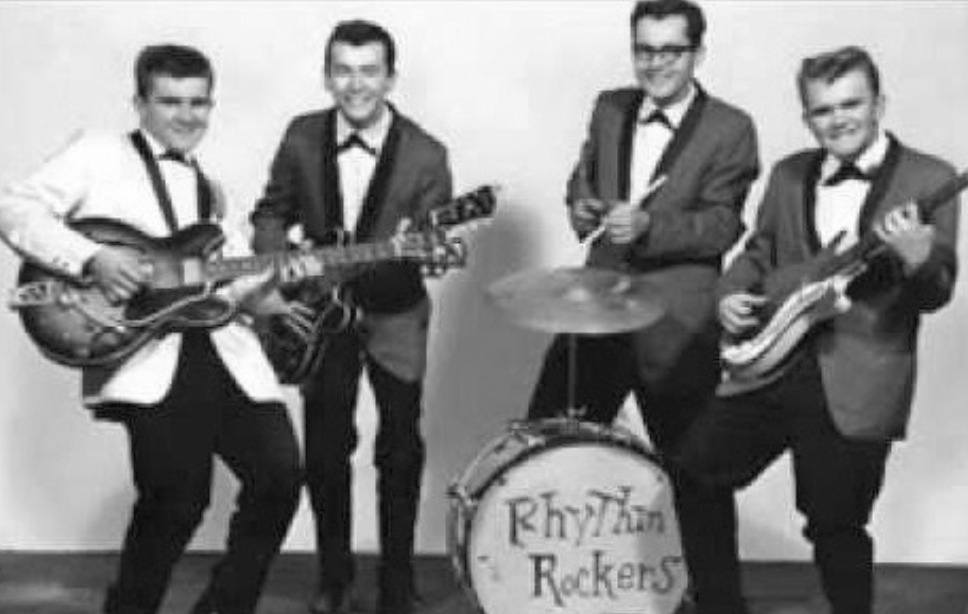
Into the third-generation, Finnish American youth were well integrated into American popular culture and Upper Peninsula teens were following the trends nationwide. An early rock ‘n ‘ roll group, the Rhythm Rockers, were an especially important Copper Country example. In the 1960s, high schoolers Dick and John Patana started this first garage / rock band in rural Alston. Calling themselves the “Rhythm Rockers ”, they first included Richard “Dick ” Patana (sax, guitar, vocals), John Patana (bass, keyboard, accordion, vocals), Tom Hiltunen (guitar) and Jerry Tahtinen (drums). They were all Alston Finnish boys. Their sister Brenda Patana often joined is as a vocalist.
The band lasted for about four years until the players started to leave the area and replacements were hard to find. One of their first performances took place at a dance at a roller rink in Ontonagon, and the band’s reputation grew as they played throughout Michigan and neighboring Wisconsin. I remember them playing a junior prom at Baraga High School.
Their recording activities took place in the early 1960s, when both their singles were released on their own “Copper ” label. For this first journey into the recording studio, they traveled to Lansing to tape “Count Down ” and “Unchained Melody.” “Unchained Melody ” was chosen for the record because “ it was the most popular slow song in the Rhythm Rockers’ repertoire,” John Patana said at the time. Their B-side was “Count Down,” an original tune composed by Dick Patana. That song is a lively California surf instrumental, recalling the Ventures. The Rhythm Rockers ordered 5,000 copies of “Unchained Melody ” which they sold to band patrons between sets for $ 1 each. John Patana said he worked hard to sell the single during band breaks because “ each member got to pocket the money from the copies he sold.”
To publicize the record, the band had a promotional picture taken at DeMott’s Photo Studio in Hancock. The photos were inscribed with the words: “Copper Records Recording Artists.” Labels for their records were customized with the drawing of a copper ingot.
Linn Campbell said, “I knew both Dick and John Patana in the early ‘60s. In addition to the band, they both worked as construction workers building the Republic Mine. I was a huge fan and started playing with Clark Sullivan with little group called‘ The Legends.’ We played a dance in the Republic gym, and both Dick and John showed up to check us out. Their approval meant a lot to both Clark and me. I think of Dick still and wish he was still around. I can remember John playing bass on an accordion because he didn’t have a bass guitar. Dick thought it looked too lame for a rock band, and John got a bass guitar finally.”
Tom Hiltunen wrote: “The musical days with the Rhythm Rockers are among the most treasured memories of my life. From cutting class and singing in a little band room at Baraga High School, learning to be a Rhythm Rocker in Patana’s ‘ garage,’the many gigs with the band, to entertaining at our class reunions will be with me forever.” In December 1962, the band traveled to Cuca Record Corp., located in Sauk City, Wisconsin, armed with two more songs written by Patana. “Bad News ” was a rockin’ number with vocals that related the school and car troubles of a teenager anticipating a date on Saturday night with a “ really sharp chick.” The flipside was sax-powered instrumental called “Twilight.”
Both songs were taped by Cuca owner James E. Kirchstein, who also published the tunes. “The band ordered 2,500 copies to sell at gigs,” John Patana recalled. The Rhythm Rockers also recorded “Lonely Lover ” at the Cuca studio, but that song wasn’t released. Although they occasionally surface on eBay for a steep price, the two Rhythm Rockers 7-inch singles are now hard to find.
There is an extensive rock ‘n’ roll online encyclopedia in Spanish whichincludes this entry about the Patana brothers: “The Michigan Rhythm Rockers were formed around the teenage Patana brothers, Dick, and John, who recruited other friends of Finnish origin like them, from the Alston area, skipping classes and rehearsing in their garage. They also composed their own songs, usually instrumental rockabilly, and after a few performances they began to cement great fame among the youth of the area, performing both in their state and in Wisconsin. They managed to record the magnificent “Crisis ” (1959) on the modest “Gaity ” label, in neighboring Minnesota (hence many consider that its origin was from this state) which also had the no less meritorious “Twang ” on the B-side. Not content with the publicity and distribution given, they decided to form their own record label, “Copper,” in Wisconsin, where they released their version of “Unchained melody ” (1961), which they sold from hand to hand. The future did not look very promising, and desertions began when some of its members got stable and conventional jobs, while the Dick preferred not to abandon music while working.”
Garage bands of the 1960s were characterized by their raw sound and usually recorded in home garages - the only indoor open space available, leading to the genre’s lo-fi aesthetic. Notable examples include The Kingsmen, known for their hit “Louie Louie,” and all-female groups like The Ace of Cups and The Daughters of Eve. The genre was a reaction against the polished production of mainstream music, focusing instead on energy and “ attitude.”
Garage rock was not limited to male musicians. Several all-female bands made significant contributions to the genre. Garage bands played a crucial role in the evolution of rock music. They influenced later genres, including punk rock and garage punk, by emphasizing their DIY approach to music-making. The raw energy and simplicity of garage rock laid the groundwork for future musical movements, making it a significant part of music history. Those of you who like to listen to live rhythmic music (rock, country, folk) probably already know that the “Church in the Valley ” bar in Alston (formerly Alston Bar) is probably the hottest place to visit the region.
Their calendar of performances is amazing for such a remote and unassuming place. Under recently new ownership and management their humble stage has become a destination for bands and listeners. Church in the Valley is the torch bearer for the music culture the Patana brothers started. That said, the history of music making in Alston and up M-38 in the Silver River Valley could be said to be exceptional with at least four families spawning professional musicians, including mine. Eino Keranen’s Ballroom, on the Houghton County border, was a swinging place in post-war years.
Many thanks go to rock ‘ n roll historian Steve Seymour from Escanaba who did interviews of the Patana brothers many years ago. This article is meant to trigger memories for those who were young in the 1960s, and to inform younger music lovers of the Finnish connection in Copper Country popular music history.