By Kip Peltoniemi
In the last half of the 19th century, the pump organ started to be used to accompany men (folk fiddlers) at dances. The harmonii, as it is called in Finland, was a new species of instrument, only about 60 years old. What made it new—the free-reed—was not new, however. Its origins are in the sheng, a Southeast Asian folk instrument dating back 3,000 years. A few instruments invented in the 19th century, the accordion, concertina, harmonica, and pump organ, contain free reeds and produce tones from air pressure alone, without contacting a surface. The bottom of a free reed is fastened to a frame, but the rest of the reed vibrates freely from air that comes from bellows or breath. This differs from beating-reeds, such as the single-reed of a clarinet, which vibrates against the mouthpiece; the double-reed of the oboe, two reeds that vibrate against each other; or the bagpipe, which contains double-reeds in the chanter, where the melody is played, but has single beating-reeds in the drones.
The pump organ’s portability was a part of its success with fiddle groups. Earlier, smaller pipe organs called “portatives” dated back to medieval times, but they lack the versatility, volume, and ruggedness of the cabinet-encased pump organ. Though portable, as indicated by their name, portatives have fragile external pipes. Pump organs, though, could be loaded onto horse-drawn wagons or handcarts and transported to weddings or dances, although larger parlor and church pump organs are more stationary. The keyboard of a portative also has a limited range, only one to two octaves, while a pump organ can have five octaves. The bellows on a portative are pumped with one hand and the keyboard played with the other. The bellows of a pump organ are operated by foot pedals, allowing greater volume, as well as two-handed playing. Further, a portative almost always has just one rank of pipes, limiting it to one sound. Varieties of pump organs, however, can hold from one rank up to five ranks of reeds.
By pulling out stops, players open one or more reed banks. When the player presses a key on the keyboard, it opens a channel for the air to flow through to the reed. Pump away, and, voila, music happens. Initially, there were homemade builders and small manufacturers of pump organs, but Industrial Age technology soon fostered the mass manufacture of metal reeds and the factory cabinetry that helped increase the number of pump organs for sale to the public.
Prior to pump organs, fiddlers in Kaustinen, Finland’s fiddling epicenter, were sometimes accompanied by strummed kanteles, or, when playing solo, by cross-bowing adjacent strings to create rhythm and drive. Kaustinen fiddlers have explained cross-bowing to me, and there are books that explain both regional and individual styles. I am, however, a button accordionist who plays some fiddle music, so these bowing nuances are mostly lost on me. I can refer readers to a few books, however, should you be interested.
The typical accompaniment style of early pump organists in Kaustinen was often not technically complicated. The left hand just played a simple, one-note bass (the root of the chord), or perhaps would double up with its octave. The right hand played only basic chords in a major and its relative minor key.
For example, in the key of G, the basic major chords are G, C, and D, and Em, Am, and B major in the relative minor. While this style is simple in concept, players put their own stamp on it, rhythmically and temperamentally, and, just like Delta blues guitar, you gotta get the groove. Later, both basslines and chording became more developed, and solo pump organ players also began the violin parts.
To hear examples of both traditional Kaustinen fiddling and pump organ accompaniment, I suggest readers listen to an album on YouTube by a group called the Nikulan Pelimannit (Fiddlers of Nikula). Nikula is a kylä (village) just to the west of Kaustinen. The title of the album is Kielirajala (“The Language Border”), and there is also a Swedish subtitle with the same meaning, Vid språk Gränsen.
Historically, and even today, the closer west one gets to Kokkola on the Gulf of Bothnia, the more Swedish speakers one encounters, and Nikula is very slightly closer than Kaustinen. I do not know its history, but evidently Nikula at one time had Swedish speakers. My friend Janne Virkkala, a classical cellist with the Kokkola Chamber Orchestra and the founding bassist of the famous fiddle group JPP, has a farm in Nikula. He tells me that Swedish speakers in Nikula today are non-existent, and that the album title comes from a book an uncle wrote. The title may be nostalgic, but the Kaustinen area, in general, has had Swedish influence centuries longer than it has not.
To find the Kielirajala album:
- At YouTube, search for this, exactly, including the hyphen: nikulan pellimannit – topic.
- At the screen that says “Nikulan Pelimannit-Topic,” click “Subscribed”—the subscription is free. Do this, otherwise the tracks will be interspersed with other extraneous music.
- Then click “View Channel.”
- You should then see the album cover “Kielirajala.” Click on the cover and you will see a link that says “22 tracks.” Click on it. Scroll past the first tune on the album called “Napoleonin Äitimarssi” (Napoleon’s Mother March). It’s a great tune, but the “Napoleonin Marssi” we want is fifth from the bottom of the list.
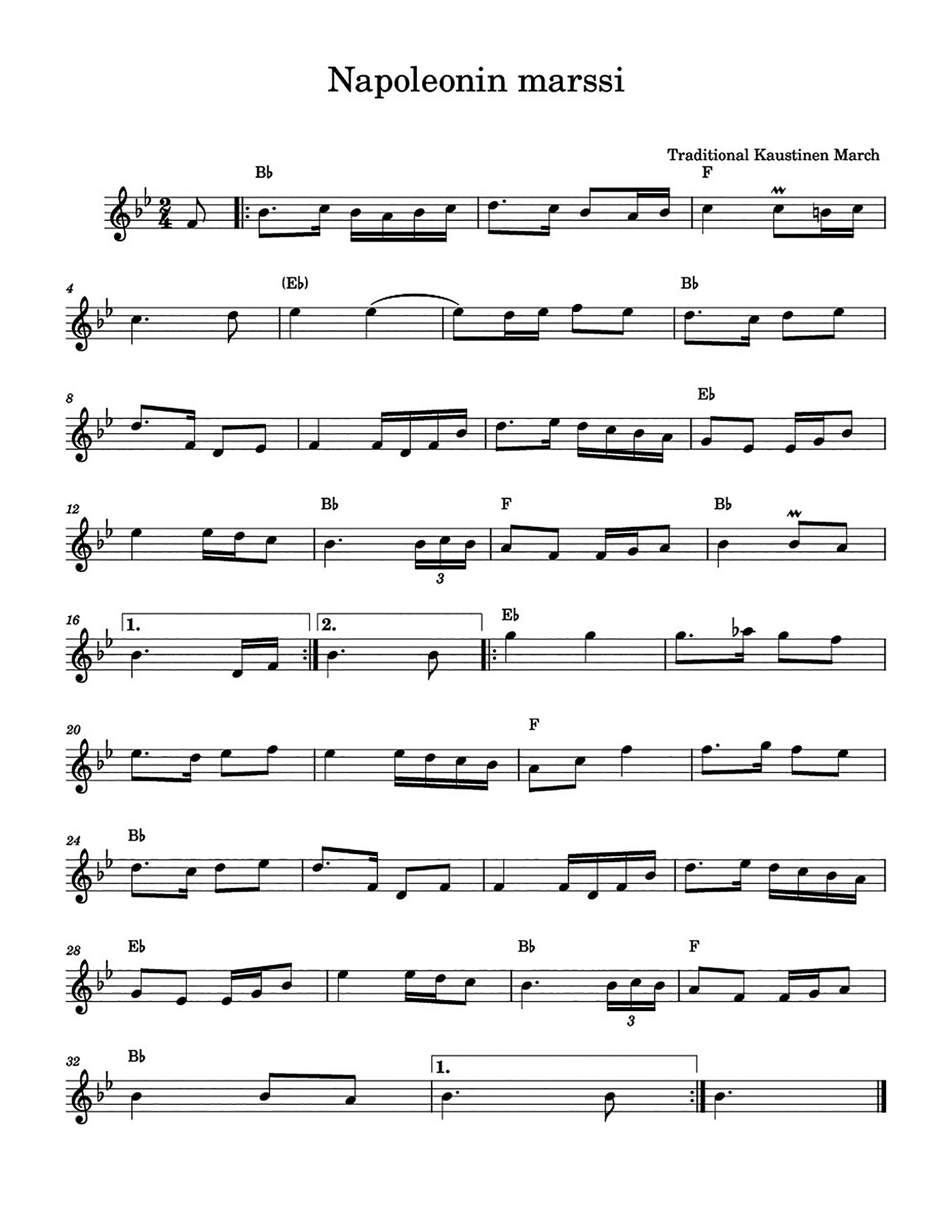
The sheet music for “Napoleonin Marssi” (Napoleon March) is included here. If you do not read music, but play by ear, don’t feel neglected. You can slow the tune down to learn it. It’s easy and YouTube has an instructional video that shows you how to do that.
About Napoleonic tunes: Napoleon had ceremonial music composed as a soundtrack to the havoc and bloodshed of his conquests, a new march for each campaign. As he crossed Europe, these melodies were spread, and, whatever the conquered peoples thought of Napoleon, at least some of them liked the music, and it lingered after the carnage. Although Napoleon never entered Finland, at least six of his marches found their way and entered the folk repertory. They all have individual names but sometimes are just generically called “Napoleon.” For example, the great accordionist Maria Kalaniemi recorded a beautiful piece arranged by Timo Alakotila with the title “Napoleon,” but it is not our “Napoleonin Marssi.” The Napoleonic tune Maria is playing is called “Vanha Häämarssi” (Old Wedding March). You can find several examples of Vanha Häämarssi on YouTube.
I especially like a version that only features a pump organ and violin duo. Search: Vanha Häämarssi – Anneli Aho. You might have to scroll a bit to find this video, but this will get you in the general area, and you can listen to the other versions on the way.
Bonus tip: If you ever need a conversation starter at parties, the Finnish names of the adopted Napoleonic tunes are: (1) Porilaisten; (2) Napoleonin; (3) Vanha Häämarssi; (4) Panolan; (5) Gästenas; and (6) Bonaparte.
Finally, to listen to an excellent, influential solo pump organist, go to YouTube and type Kaisu Forsti -Topic. Then click “Subscribe” and “View Channel.”
Wikipedia also has a short biography of Kaisu Försti, who is now 93 years old. It should be noted that she is from Evijärvi, near the invisible governmental and cultural border between Etelä-Pohjanmaa (Southern Ostrobothnia) and Keski-Pohjanmaa (Central Ostrobothnia), where Kaustinen is located.
Although the areas share many of the same tunes, and are only 18 miles apart, there seem to be more polska (not polkka) tunes in Evijärvi and Etelä-Pohjanmaa. Kaisu Försti plays two polskas on her album.
Most polskas are three-quarter time pieces, with an additional emphasis on the third beat that is not found in a waltz. Finland uniquely has some two-quarter time polskas, too.
To me, the tunes I write about are not fiddle-centric. Play them on any instrument or sing them as mouth-music. I welcome any comments and will happily share relevant information from readers, both letters and emails.
Kip Peltoniemi, 205 N Walker Ave, Apt 303, New York Mills, MN 56567 or kip.peltoniemi@gmail.com