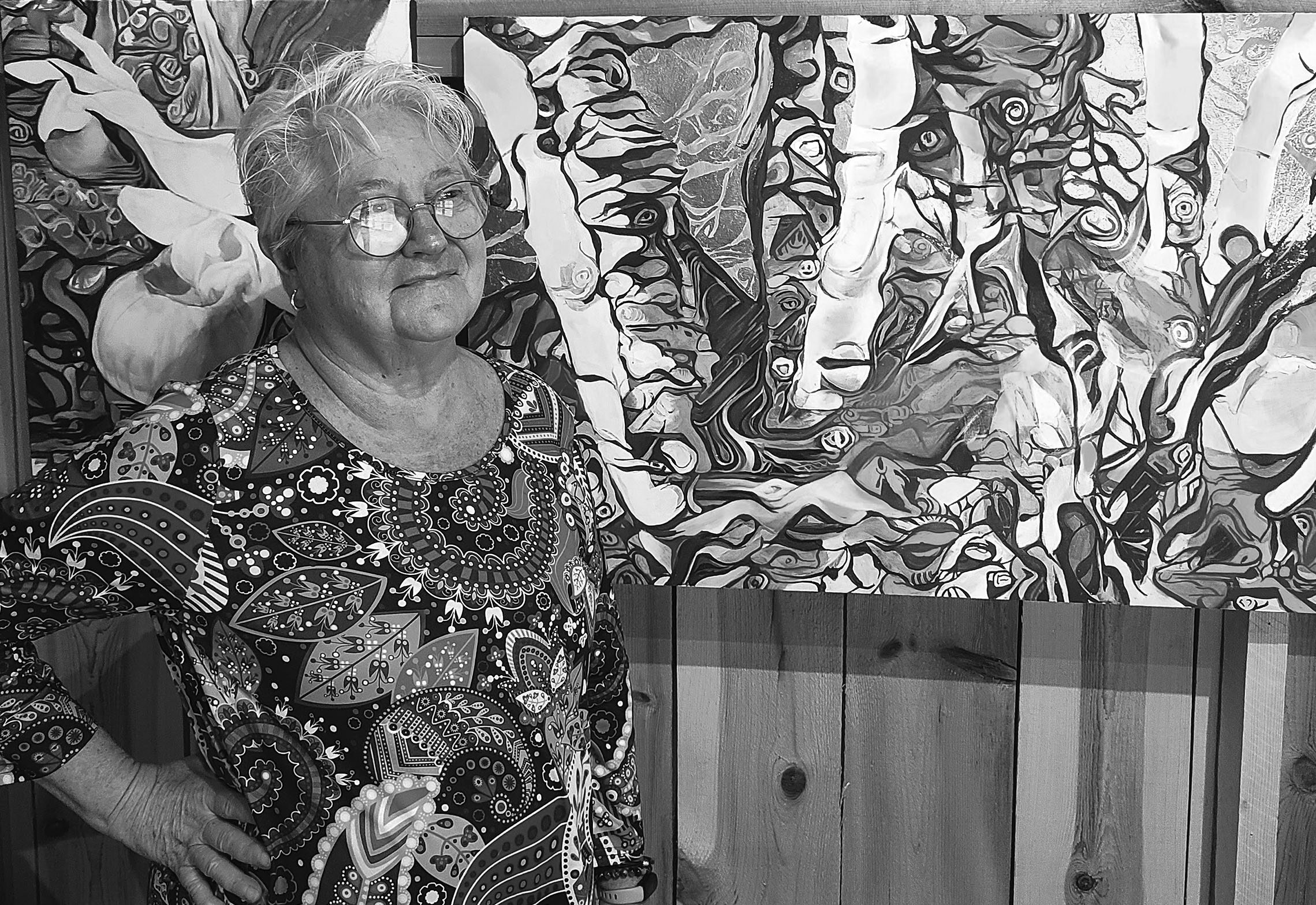
On a wooded 40-acre patch of land tucked snugly in the center of Minnesota’s Finnish Triangle, artist Mary Erickson dwells in the log house of Finnish immigrants, and expresses that beauty in art. Not photographic realism. Not inaccessible expressionism, but a hybrid impressionism. Look at her paintings long enough and you’ll understand them.
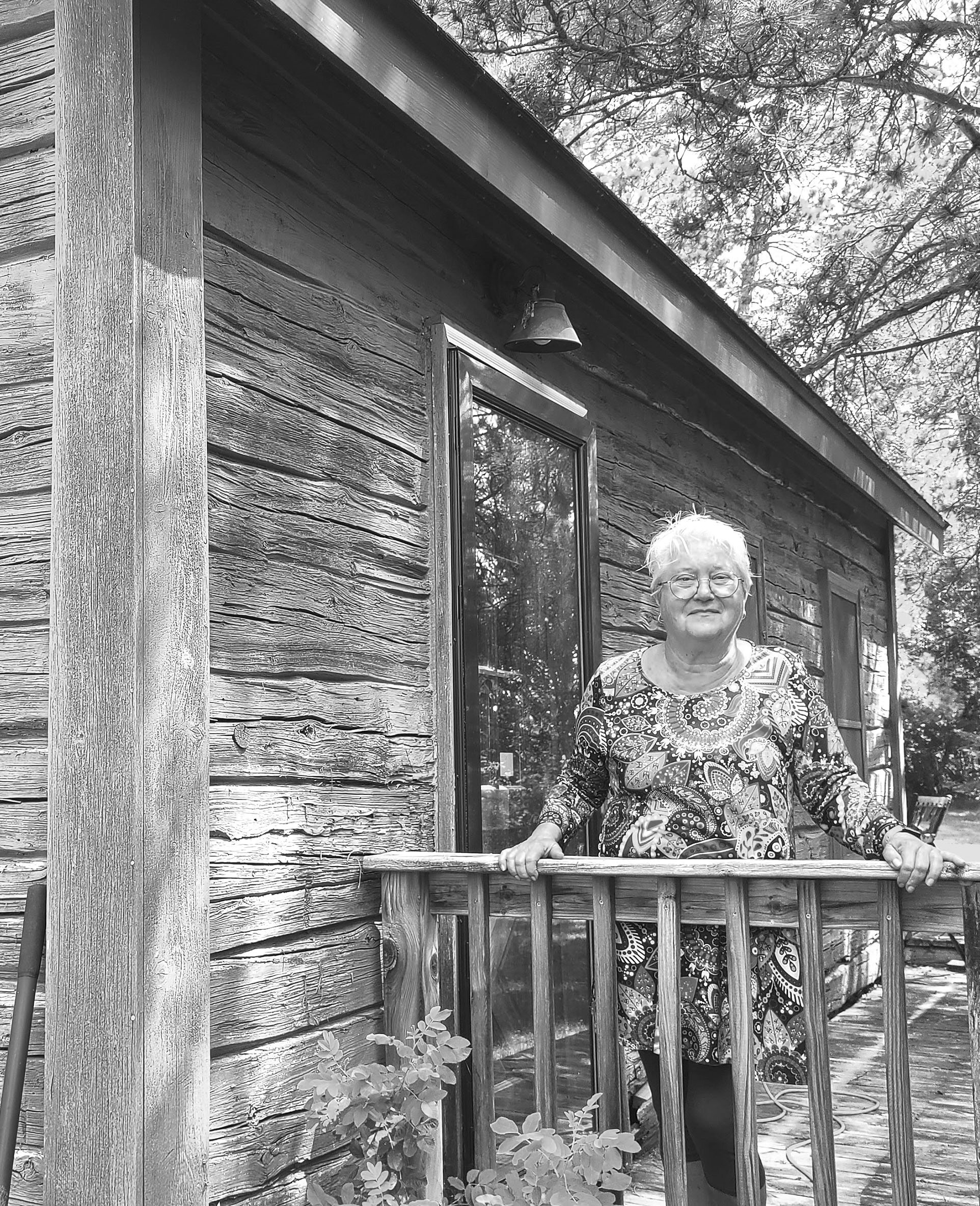
The farmstead was first settled at the turn of the last century by John Marjamaa. No surprise, he built the sauna first in 1902, then the log house before wife Rose arrived in 1906. John was a farmer; Rose was a midwife who assisted in the delivery of area babies. Despite their demanding schedules, they found time to raise ten children of their own. The descendant grandchildren visit the family farmstead regularly and are grateful for the work Mary and husband Brian have done to restore and maintain it.
When the Ericksons bought the 40 acres in 1986, the remnants of a log barn graced the driveway entrance. The insurance company saw the barn as a potential loss and demanded its removal. Undeterred, the Ericksons demolished the barn and constructed a studio for Mary’s art on the barn site. Close your eyes, stand quiet in the studio, and you feel the original Finnish energy that occupied the space. Mary is inspired by that energy, and her work shows it.
Property owners between Marjamaas and Ericksons rearranged farm buildings to add to the house, created rooms, not with an eye for historical accuracy but with the intent of updating them to contemporary levels of efficiency and comfort. A field rock fireplace was added to the living room which, oddly, feels appropriate. The walls of the living room are the original logs lovingly re-chinked and refinished. The beadboard ceiling is replaced with a cathedral exposed beam design retaining the original beams. A staircase was added to a small loft area. The newer frame construction portion of the house includes a kitchen and bath, the likes of which you’ll not see in a 1900s Finnish log cabin.
Walk with Mary on a warm summer morning that promises to be a scorcher by noon. Start at the path leading to the tree-shaded sauna which obscures the root cellar, the juureskellari, behind it, and the path to the Blueberry River beyond it. Past the granary converted to a post-sauna dressing room; past a one-holer outhouse with the requisite star cut in the door. Past the house where Mary removes decayed particles of logs in the constant battle of renewal.
Lazy pillow clouds splotch a sapphire blue sky. An osprey rides the thermals and updrafts, circling its nest atop a utility pole where nestlings gawk and squawk. Oaks and ash and Norway pines are a palette of greens. Weeds hug the path to Mary’s studio where she spots a monarch butterfly caterpillar munching on milkweed leaf. A tiny grasshopper hops to safety in the weeds. All around is the aroma of ripe foliage. All around is the deafening silence of a hot summer day isolated deep in the woods.
Mary Guttormson Erickson was born and raised in Fergus Falls, Minnesota. Her mother, a teacher and librarian, exposed her to reading and music. Her father taught her the outdoors regimen — firearms, fishing, canoeing, camping, mountain hiking, skiing.
At the junior college in Fergus Falls, Mary studied art under Charles Beck, from whom she learned to see art in nature. This led her to enroll in the Minneapolis School of Art and Design from which she earned a bachelor of fine arts degree.
After her marriage, Mary and husband Brian moved to Mexico. The bold explosion of color in Mexican art coupled with living with children in close proximity neighborhoods expanded Mary’s concept of color and what art can be and is all about.
Returning to the U.S., Mary became a Montessori teacher and taught in Arlington, Virginia where, in conjunction with the Kennedy Center for the Arts, she experienced art as collaboration.
Mary’s art experience includes a residency at the North Country Museum (now Nemeth Gallery) in Park Rapids, Minnesota, where she painted an entry mural; another mural at the NDSU Lutheran Center; and an altarpiece for St. Mark’s Lutheran Church in Fargo. Mary has two studios — a winter studio in Los Cruces, New Mexico, and a summer studio at the Blueberry River Farm in Menahga. She states her intent: “I make art to celebrate the beauty in nature and the beauty of people I’ve known.”
Mary’s art is currently featured in a one-woman show “40 Acres for 40 Years” at the Kaddatz Gallery in Fergus Falls. The paintings are pastels, small and unassuming, but filled with latent nature motifs, hidden objects, and a different interpretation for everyone who views them.
“Galleries are the spaces that grow creativity, imagination, and joy,” said Mary.
“The Kaddatz is that kind of place and it is an honor to share my work here.”