By John Luthens
Author's note: This is an excerpt from the novel Taconite Creek.
Ernie steamrolled into the lore of iron-mining history with the invention of the sauna train. It was more than just a train. It was a gateway into the reaches of Taconite Creek.
Ernie conceived the idea one night while sitting in the sauna he'd built on a hill overlooking Lake Superior and the Ashland ore docks. His sauna was simple enough, nothing more than a wood-burning stove with rocks atop it, a bench, and a barrel of ice water from the lake. Wood smoke rolled across the shore in the breeze; the sun poised to burn into the western horizon of the lake. The sauna was majestic in its simplicity.
Ernie's sauna quickly became a popular place for the mine workers to wash away the ore dust and grime from their day's labor. In return, they hauled birch, jack pine, and oak, splitting and piling until the sawdust and the wood piles ringed the outer walls of the place. Scented smoke rose across the docks like a dinner bell, wafting into the Ore Dock Saloon, a backwater eating and drinking establishment resting just downwind of Ernie's sauna. Barrels got tapped and tables wiped down hurriedly as men piled out for their nightly steam bath.
The masses never touched the split oak as that was agreed upon in their unwritten sauna-usage contract. They contented themselves with the quick-burning and more moderate heat of the softer woods. They'd wash up in the warming sauna, fill the water barrel from the lake shore below, and disappear, new and fresh to fill their own barrels in the saloon. Ernie gave his friends first dibs, partly due to his good nature, partly due to the fact that he wouldn't roll in 'til the last trout stopped biting, but mainly so the sauna stove would be burning just right when he arrived.
When the nighthawks and bats sounded along the shoreline, Ernie stowed fishing gear, straightened up the woodpile, and waited till the time got right. Then he sauntered into what he called “Da real sauna!”
On a given night, it was anybody’s guess what heated merriment the swinging doors of the Ore Dock Saloon would reveal to Ernie’s pals. There was only one certainty: In “da real sauna,” after he got it stoked to his liking, Ernie’s world rivaled the gates of hell. His bath became a cleansing ritual where, as he put it, “A person sweats out all da clutter to make room for da mysteries of life.”
Indeed, many a great thought was sweat out of Ernie’s head in his sauna shack overlooking the peeling ore docks and piles of ore along the Lake Superior shore. But to hear him tell it, the sauna train was the pinnacle. “Vell, I sit on da bench sweatin’ good. It vas a hot fire, and I pour darn near da whole barrel of vater over da rocks. Dat steam, it’s really puttin’ out, you bettcha, da oak logs vas cracklin’ and poppin’. Den it just popped out of my brain – why not make da engine run like da sauna?”
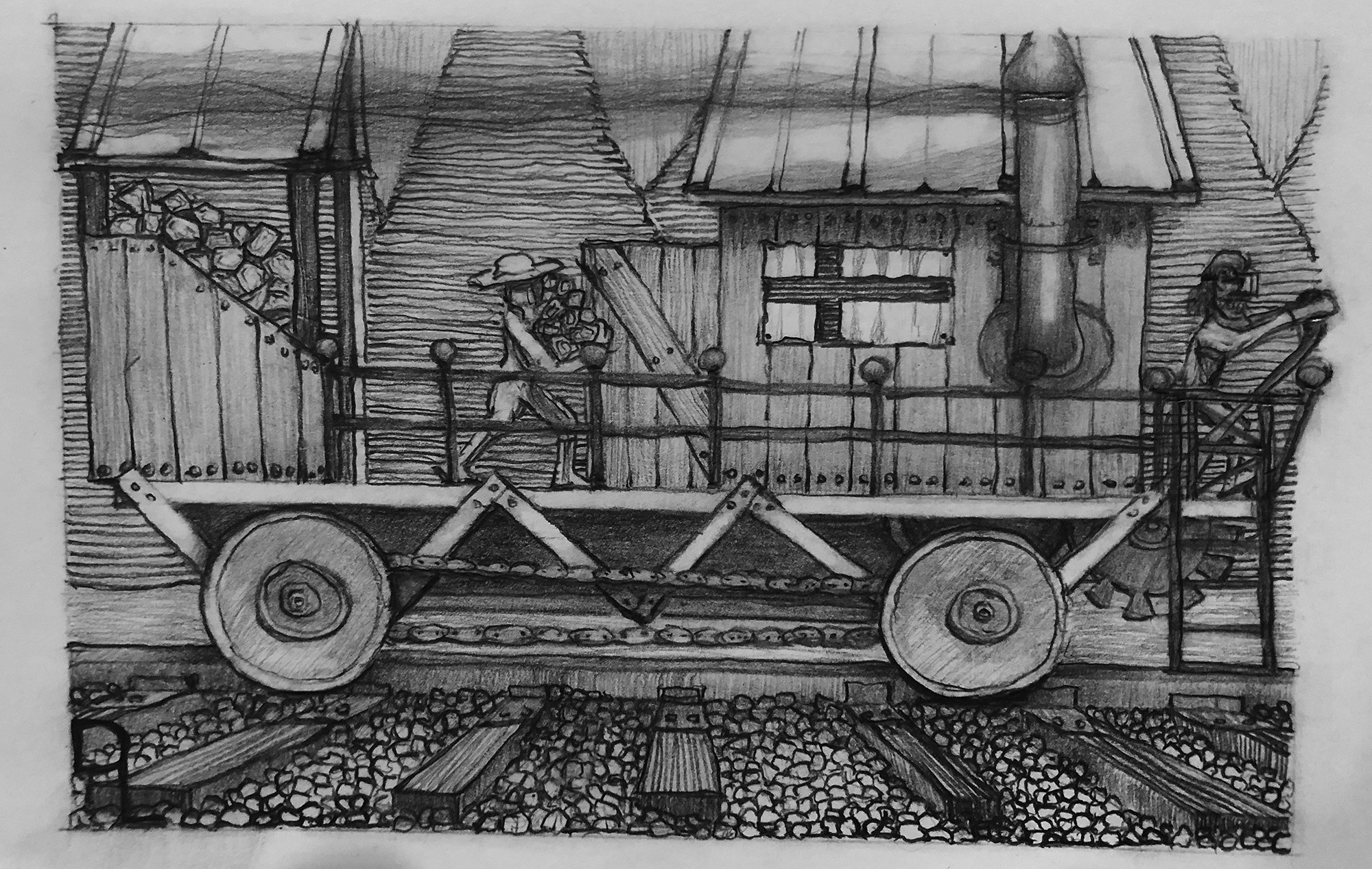
Ernie’s sauna train was born in a steam-induced Eureka moment. He locked himself in his shop for the better part of the winter, coming down to the docks for wheelbarrows of cast-off iron that hadn’t made the final quality cut. There were special orders from the hardware store: bolts, rivets, sheets of plating, and copper tubing. He made long forays into the farm country to talk with farmers about their tractors. Pounding hammers and clanging steel rang over Ashland till far into the night. Putting it together was something only Eli Whitney, Albert Einstein, or Ernie could accomplish.
When the banging and clanging and steam finally settled, iron-hard taconite rocks rested atop a wood burner with a vat of water suspended above. Water fed the hot rocks into a steel casing above, trapping the steam and channeling it into a series of ever-narrowing copper tubing until it was finally released in a hissing jet to turn the train’s pistons.
Riding on big rubber wheels with its stove burning all types of available wood, the train itself was compact. Oak burned best, and the men who used Ernie’s sauna were soon hard-pressed to keep the woodpiles stocked. It reached a point where they started thinking about taking a cold bath in Lake Superior rather than buck wood to keep the train running. Homesteaders and farmers in the backcountry between Ashland and Superior soon learned to keep any lumber – or chairs and tables for that matter – out of sight when Ernie’s train came chugging over the horizon.
On the day of its unveiling, the sauna train was the hot topic in the Ore Dock Saloon. Ernie rolled his creation out of his woodshed workshop, and all the iron workers piled out of the saloon to watch. Uncle Jack stalked out, too, pacing around the train, stroking his chin with thumb and forefinger. Ernie followed close behind, looking the part of an auto seller ready to overcome a buyer’s objections.
Uncle Jack outpaced Ernie or, maybe, Ernie simply stopped to wait for him to circle around to the other side. They ended up facing each other, like two gunfighters ready to have a go at it.
“Well, the steam engine’s already been invented, so you’re a little late there,” quipped Uncle Jack. “But if there’s ever a market for a steam bath on wheels, then I reckon you’re going to be rich.”
“Maybe I get rich,” said Ernie, “but I know one ting for sure.”
“What’s that?” growled Uncle Jack.
“I vill not be cuttin’ rail ties and hammerin’ down track. I save dat for you. You picked rocks at da farming university – probably your back is used to dat verk.”
“I ain’t doing the hard stuff while you sit and polish this here contraption,” said Uncle Jack. “You got to pitch in. We’re supposed to be a team, even though I ain’t sure which side you’re playing for.”
Ernie kicked one of the train’s tires. It echoed like a bass drum. He waggled a hairy finger in Uncle Jack’s face, like a schoolteacher making a point with an unruly student. “Ya, but see da veels are rubber, yust like dem big tractors. Dis here train don’t need no tracks!”
The mine executives had come out to the ore docks to see the sauna train’s unveiling, too. They huddled in suits and ties, in tight circles of conspiracy, discussing the possibilities of profit. A faraway look came into Uncle Jack’s eyes. He was discussing the possibilities in the tight-circled boardroom of his own mind.
The hard-knobbed wheels of the sauna train were grooved and could run on rails, if necessary, but it wasn’t a prerequisite. The train’s power had the power to pull a fully loaded car of iron ore. As a reconnaissance vehicle, it was far above anything yet conceived of in the taconite range country. Wooden ties and rail spikes weren’t necessary, so the potential of time and money-saving – at least on paper – really intrigued the mine executives. There were places the sauna train could roll into that a conventional train would find unreachable; steep ridges and bogs, without the need to grade and reinforce pathways. The nods of approval from the suits-and-ties amounted to a majority.
Uncle Jack, meanwhile, voted in the trout-filled boardroom of his own head. Cedar swamps and dark-running rivers and lost places of trout. That intrigued him most of all. “All right, Ernie. You sold me on your steam-train idea. You do the driving, and I’ll navigate. But I’ll tell you right now: If she tips over in the swamps, I’m bailing out like a rat on a sinking ship.”
Hipboot Jack was born, compass around his neck and flyrod in hand, riding the sauna train to glory in his waders. There were no checks-and-balances in place to stop it. The sauna train rolled, cobbling out taconite rock from every network of hidden water in the range. There were warning signs, but they weren’t heeded by anyone but the working men of iron. The men smelled Taconite Creek coming in the impending storm. But the company was making money, and money is the ultimate blind spot to impending disaster.\