By Casey Norlin
There is this saying that your ancestors never die, that they live through you. It is thought-provoking when I ponder about the thousands of years where my ancestors lived in the Scandinavian region; in the land of Midnight Sun, persisting in their rural farms or villages under the control of either Sweden or Russia, everyone of their successes and struggles, births, and deaths through salvation and survival and here I am a part of their history, written in the codes of DNA passed down through the generations from the names of people I will never know.
When I listen and look at the Finnish language, I think it is crazy to try to learn or pronounce but it’s strange to comprehend that almost all my ancestors in history probably spoke Finnish with ease. It’s interesting that in Lord of the Rings the Elvish language was influenced by Finnish and that since Finnish is so different from the surrounding languages in fairy tales and stories the Finns were viewed as enchanters, witches, and sorcerers. In fact, I am the recent one because English has only been used in my family since the early 1900s when my family members first immigrated to America.
Yet the hardy Finn is more than just the language, going to sauna, or remembering a folk dance to polka but something innate in you. Sort of like our German Shepherd. She isn’t in Germany; she isn’t watching sheep but the instinct inside her is still there as her eyes dart back and forth watching and protecting our children playing in the yard.
Warfare and military history have always intrigued me, I can remember looking at picture books before I could read and still remember a series of kids history where Volume 7 was the Civil War where the soldiers wore Blue and Grey, WWI where the good guys wore the dough-boy helmets, gas masks, and fought in trenches, then there was WWII where things got confusing. I remember the photo of the Germans surrendering to the people with the Red Star. But was confused when the Americans with the White Star were fighting this Red Star in the Korean and Vietnam pictures a book later. There I was trying to make sense about national security strategy, alliances, morals and ethics, and Just-War Theory before I could read. I guess it was my first probing into U.S. Army War College.
I was interested in order as well. I was never fascinated by superheroes. For some reason the good guys who were all colorful with capes never really seemed as cool as the stock military-style bad guys who had discipline, uniformity, order, rank and structure. I guess that makes sense in that Finns are known for being orderly and organized not showboats or boastful colorful superheroes.
Ironically, I was never drawn to sports that would be considered aggressive or combative. I think of the early lives of famous West Point American generals who were of Irish, English, Scottish, Germanic descent and that they usually list football, wrestling or other combative endeavors in high school or at West Point. Conversely the Finns are not known as the aggressors yet still have determination and warrior spirit. I remember when I was a volunteer firefighter and I had just exited a house fire and joked that I was always cautious and was never thrilled with risky behavior or extreme sports. Yet I was just inside a burning building. My friend gave me a good point; it is because of service. You are doing something risky because there is service, meaning, and purpose behind it.
Could my ideals of service be influenced by my ancestors? The Finnish people’s strength of volunteering and service to the community is common in their culture. The word “talkoohenki” means “community spirit” or the spirit of communal work. When compared to other NATO members its military is enormous. Its military size is almost 900,000. Pretty impressive for a nation of only 5.6 million.
Once again out of all the U.S. military branches I was interested in was the Army National Guard. The citizen-soldier was what always appealed most to me and was the best way I could serve my country while still being able to stay and live in my community.
I’ve been in the Oregon Army National Guard since 2017. The medical unit I am assigned too deployed to Kosovo in 2024-25 to assist with the KFOR peacekeeping mission. NATO is still involved with peacekeeping in the region. As a dentist I deployed with Charlie Med (medical company) 141 Brigade Support Battalion to Camp Bondsteel to provide medical care to the United States service members based there.
While overseas we were introduced to all the other NATO medical counterparts serving on the KFOR mission. It was interesting to meet and talk with some of the Finnish military and see the value of higher education in their society. Many of the soldiers were highly educated even above their military specialty. Medics who are nurses on the civilian side and almost every other I talked to was an engineer or in engineering school.
In my military experience, one thing I discovered I enjoyed and was good with is rucking. Boots, military uniform, rucksack, water, and sisu.
When we got to Kosovo there was a Ruck March put on by the Danish military called the Danish Continent March or Dancon, so we all trained for it. We were told it was 12 miles. I had done two Norwegian Ruck Marches over the years which are 18.6 miles in under 4.5 hours and I could ruck around Camp Bondsteel and do 12 miles in under 3 hours after a normal workday, so this shouldn’t be a problem at all.
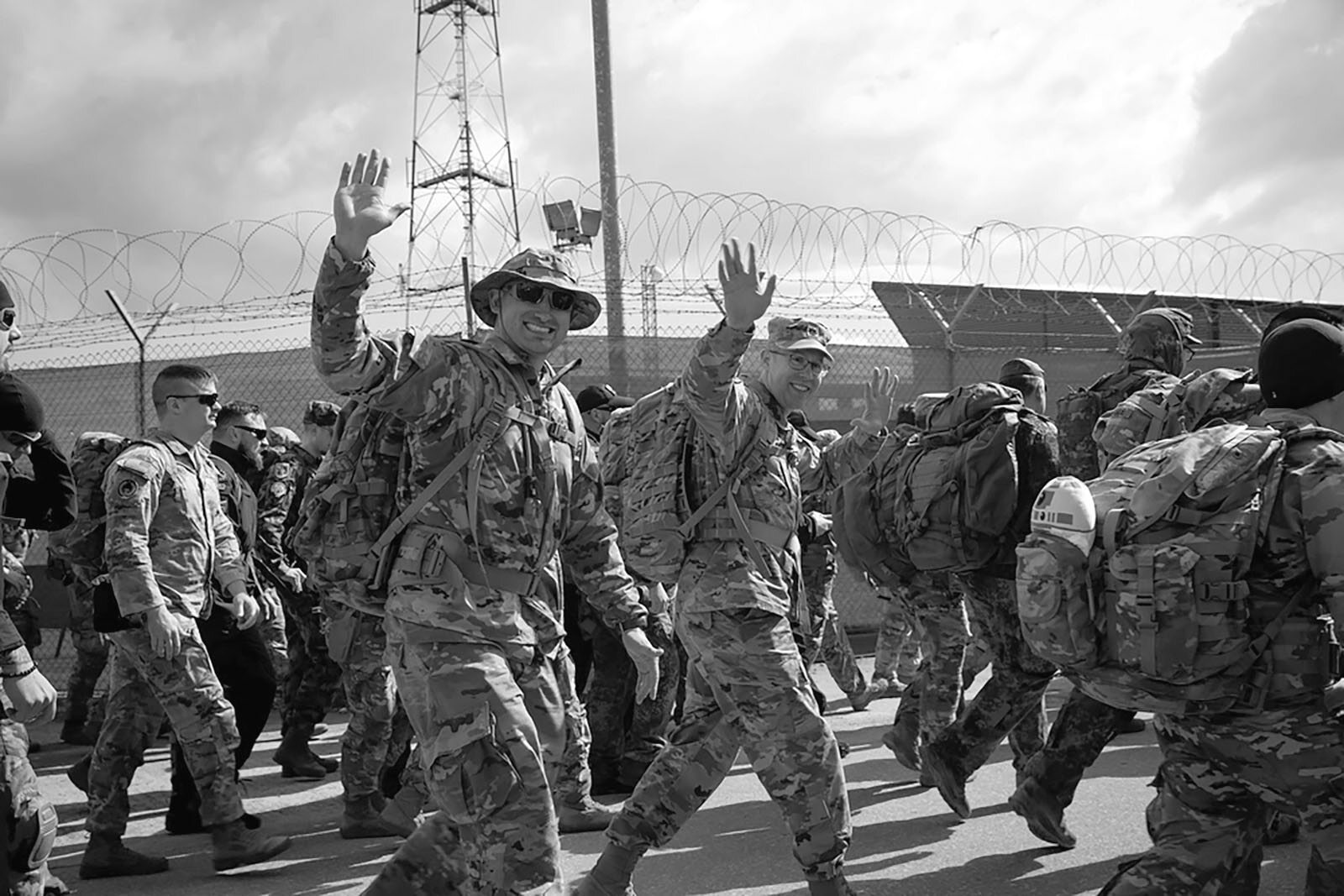
On the morning of 12 April 2025, hundreds of NATO members from around the world arrived to start the Dancon Ruck at Camp Novo Selo. It was overcast, cold, and windy. The question was do you dress in your warmer clothes or do you just go lighter. I opted for the light summer’s army fatigues. Sure, it might be chilly standing there, but the rucking will get started soon enough and the weather called for a sunny day.
Danish military members introduced the Dancon Ruck March over a loudspeaker and then we were off. It was a very festive, camaraderie environment. There was a mob of soldiers. Some in the front were running it to make time but the rest of the masses were just slowly moving out. After a few miles it would clear out and we were not so jampacked stepping on each other’s bootlaces. For the first few miles it was joyous and exciting. We were trading patches and flags with other units cheering on our friends and laughing with some stranger from the other side of the world for a few seconds as either one sped up or the other slowed down.
I started at a faster pace as we were walking through a Balkan valley of farmlands and villages when I looked to the left and noticed. We were in a narrow valley and that giant ridge was something we had to cross. At the top of the mountain, I could see dots. Those were soldiers.
Coming to the steep hill I started my climb. I was sweating and breathing heavy, but though I was assembled in America my Finnish DNA blueprints made me perfectly designed for it. The Finns are known for their long-distance endurance. Probably came from my ancestors trekking through snow, ice, forests, and bogs where if you stopped moving you would freeze to death. While soldiers were slowing down, I was passing them. Each stride gets a few extra inches, a few extra inches, a little closer to the top. Maybe it is the Finns genetics of time management and efficiency.
I joke in my dental practice when I get the tooth extracted quickly and the patient is surprised the surgery is done, I joke and say I am lazy so I just wanted to finish sooner but if you want, I can stick it back in and wiggle it around for several minutes to get your time worth. The same was true on this day; as soon as I get to the top, the sooner it gets easy! Soldiers were cheering and were surprised to see this American major quickly pace up the hill.
Once at the top I cheered and let out a few sisu hollers that echoed down the valley! I caught my breath and jogged walked, jogged walked down the hill to the other valley.
About halfway through I noticed some soldiers with the Finnish military camouflage, so I walked on over and introduced myself. We traded patches and started a conversation. I mentioned about my visit to Finland and how my family came from Finland in the early 1900s. It was a good chat. I asked them if they knew any Finnish jokes and I told them one that I had made up. Why do the Russians do so bad at the Winter Olympics? They have never been good trying to pass a Finnish line in the snow. They all shared a laugh.
One Finnish soldier was in his mid 20s and an engineering student. We had a good chat talking about where we grew up. He grew up in the country, went to lakes, and had dirt bikes. I laughed and joked that I grew up in the country as well with horses, always loved water going to our family camps on the lakes in Michigan. I joked and said that from across the world we still have the same outdoor hobbies and interests.
I looked at my Garmin watch. We had already passed mile 12 and Camp Novo Selo was nowhere in sight. That put us in for a surprise. The last several miles were a bit brutal. I was chewing and sharing sugar gummies, and we munched on our crumbling bag of potato chips for salt and carbohydrates.
Two people separated by thousands of miles. I wondered what would have happened if my ancestors hadn’t left Finland? Would I have been in this same march as a Finnish soldier if they hadn’t left? Would I even exist?
Where my ancestors differ from me is that they went to start a new life somewhere while I am a person who didn’t want to leave but stay close to my family and community I grew up in. Did their grit, determination, and sisu of a Finn bring them to America which no longer made them Finnish?
Getting hot? Yes. Sun beating down on us? Yes. Water low? Yes. Do we see Camp Novo Selo? Yes! I can still remember the white-orange striped tower marking the Camp and end of the march.
Finally, after almost 17 miles we made it across the line and earned the Dancon Medal and picked up our certificate. The Finn apologized and said he hoped his English wasn’t too bad during our conversations on the ruck. I laughed and told him his English was great and that his accent was just a tiny bit stronger than my family members who live in Michigan.
Here we were the same Finnish people from the same ethnic tribe who shared a few moments. Different or not-so-different people, separated by thousands of miles, serving under two different flags and militaries that were played out by the decisions of our ancestors, world events, military conflicts, and government policies. Your ancestors never die; they live through you and their decisions influence and affect us every step of the way.