By Dr. Jeanne (Wierimaa) Kemppainen
As third-generation Finnish Americans, my brother Mike and I lived in two worlds: the fast-paced American mainstream, and the quieter, more insular world of immigrants.
During the school year in the late 1940s, we lived in Dearborn, Michigan, in the shadow of the Ford Rouge Complex, the largest integrated car factory in the world. Several of my family worked there. The surrounding community reflected Henry Ford's strong belief that immigrants should give up their old-world traditions and fully adopt American values, language and behavior. Our brick home sat on a quiet maple-lined street; Mike and I walked six blocks to a private Lutheran school and spent Saturdays at the neighborhood movie theater watching cowboy pictures. It was a fast, energetic world full of opportunity.
Six hundred miles north, our summer world was another country entirely — the Copper Country. Michigan’s Upper Peninsula felt cut off from the hurry of city life by gravel roads and quiet lakes that mirrored the sky. Finnish was still spoken in the shops of Houghton, some of the older women still wore long dark dresses and small straw hats of the old country to church, and Sunday mornings carried the past like a held breath. The family farm was tucked into a clearing surrounded by hayfields and wilderness—no running water, no indoor bathroom, an old-fashioned icebox instead of a refrigerator, a Finnish smoke sauna whose woodsmoke drifted across the yard. Mike and I raced out of the car as we arrived on the farm at the beginning of our annual summer stay as if we’d just won first prize at the state fair, racing straight for the giant rock in the hayfield to the west of the house that became our ship, our fort, our whole imagined world.
Finnish was the language of the house and our grandmother was center of that world. Grandma Pelkonen didn’t speak English, but we always understood her — a motion toward the table, a nod toward the door. She was short and stout, her face deeply tanned and mapped with wrinkles, her head always wrapped in a white huivi. She had crossed an ocean, buried a husband following a tragic copper mining accident, and raised nine children alone on that farm, and all of it seemed to live quietly in her eyes without ever being spoken of. She rose before dawn to build the fire, boiled her coffee in a soot covered pot that fit down into the well of the kitchen woodstove to the thickness of tar, poured it into a saucer to cool, put a sugar lump between her teeth and slowly sipped the coffee from the saucer. She introduced us to viili, a ropey homemade Finnish yogurt. Without knowing it, Mike and I were being shaped by her example — learning, just by watching her, what the Finns mean by sisu.
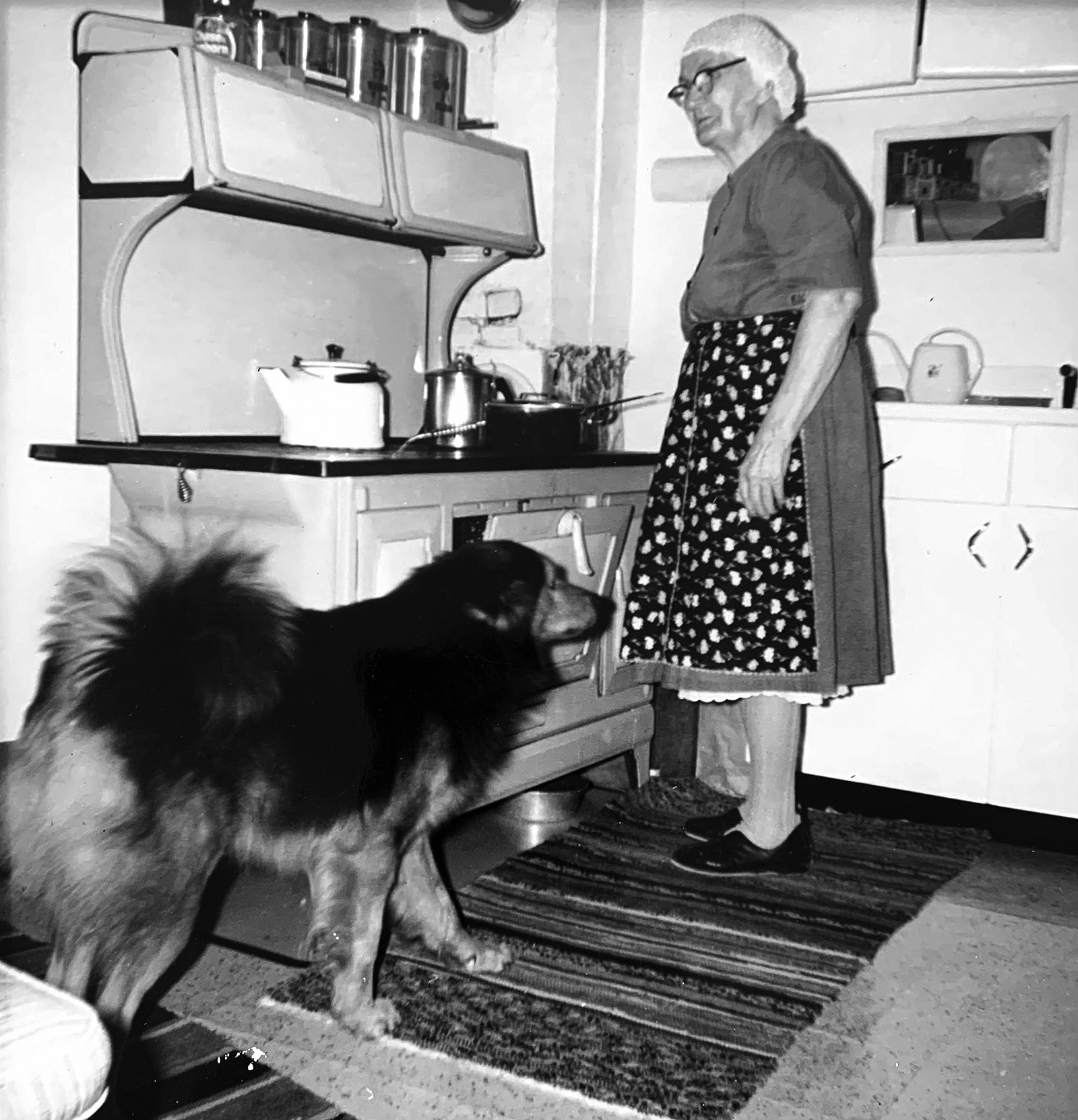
Our magical summers meant berry picking, watching bears at the town dump, long walks down the old Fox Farm Road to the abandoned fire tower deep in the forest, and Wednesday and Saturday nights in the smoke sauna our grandfather had built, where my own mother had been born. My grandmother even tried, in secret, to teach me a few words of Finnish — maitoa, voita, leipa — hushing me with a finger to her lips whenever she heard my mother’s footsteps. She seemed to understand my mother’s reluctance to have my brother and me learn to speak Finnish. Those whispered words felt like the two of us sharing something no one else was allowed to have.
That secrecy turned out to be the whole shape of our childhood.
On the farm, Mike and I were Finnish Americans without question. Back in Dearborn, holding on to that identity was another matter. We carried it like something fragile and hidden — not from shame, but because we knew our friends wouldn’t understand. One summer, fresh off the farm and still full of it, Mike couldn’t wait to tell our friend Bobby about sauna night — how Grandma taught us to cut birch branches and bundle them into vihtas for beating the skin in the steam. Bobby’s face went strange and still. “When people come to visit you,” he finally asked, “they take a bath? And slap themselves with tree branches?” Nobody knew what to say to that. After a long silence, someone called out, “Let’s choose up sides for softball,” and we were grateful for the out. It was easier ground. Better to let our friends see what they already understood.
Back in Dearborn, it seemed that our mother encouraged us to completely sever ourselves from our culture, yet we were living in the midst of it. Like so many children of immigrants, she wanted something easier for us. “Be an American.” We didn’t understand then why she’d bring us to that magical place every summer and then ask us to erase it the moment we got home. We only knew we were expected to behave one way with our immigrant family and another way with our friends — and that we’d become experts at knowing which mask to wear.
There was one gift in it, though. Mike and I learned to switch identities faster than someone fleeing a burning house, and just as fast to switch them back — especially on weekends at our Finnish grandparents’ house nearby in Dearborn, where Grandma Adolphina’s kitchen smelled of pulla and the comforting sounds of Finnish filled the house. Where Grandpa Wierimaa put records on the old record player that sat in the corner, and danced with us to the sounds of “Joukse sina humma” and “Maallman Matti.” Yet we were denied real Finnish lessons by grownups guarding their secrets, so we made up our own gibberish version of the language, rubbing our chins and nodding at each other solemnly and murmuring the one word we knew for certain: “Joh.” Yeah.
We never did learn the language. It’s a loss Mike and I mourned for the rest of our lives. But those summers — half-hidden, half-celebrated — gave us both strong roots and a fierce pride in our Finnish heritage. We learned the values, strong traditions, that we cherish and have carried us well through the years and now make sure to pass on to our children and grandchildren.