By Jim Kippola
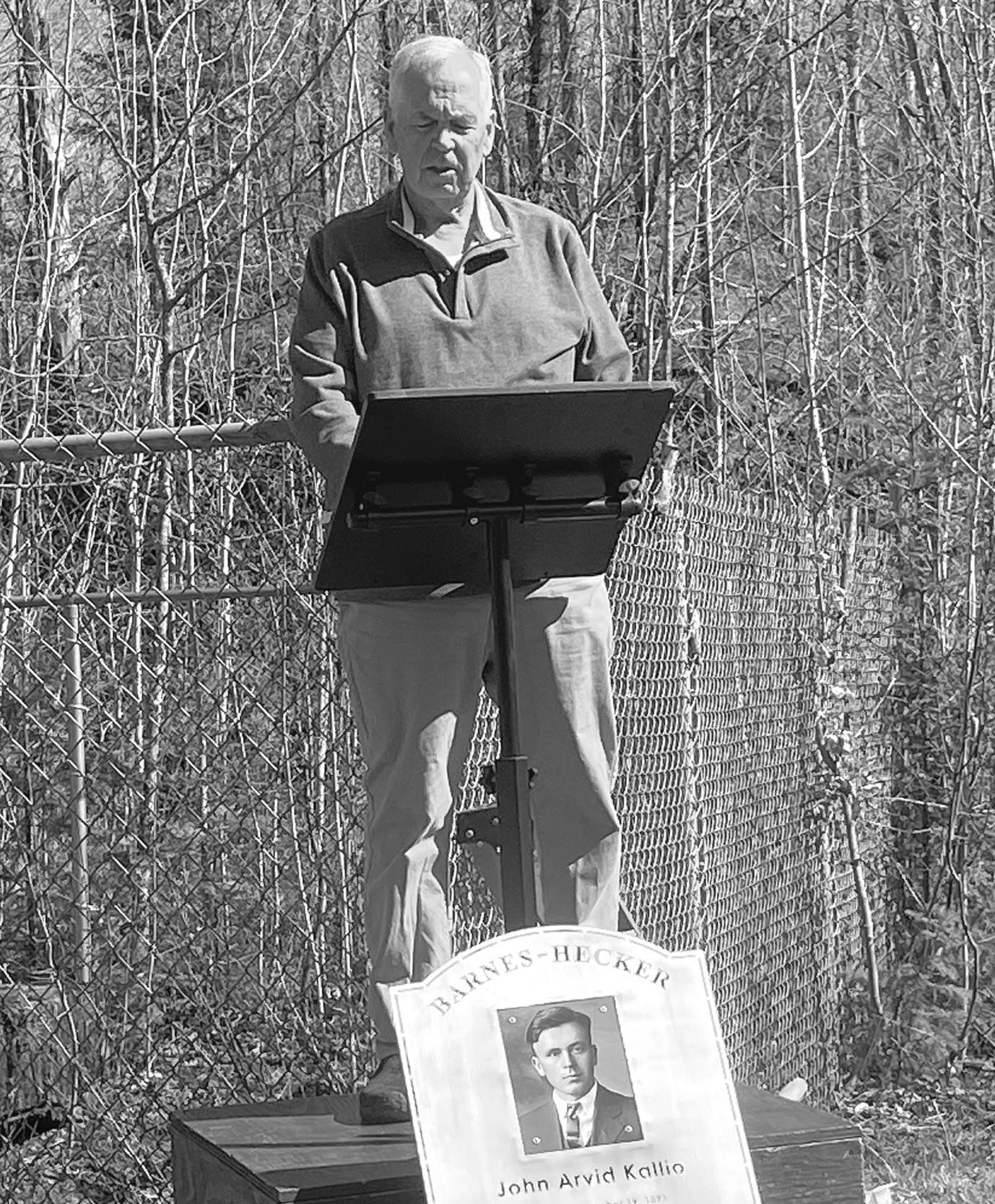
Our country has embraced the practice of memorials as an essential part of our social fabric, and when there has been a loss of life, it goes without question that proper respects are paid. Nothing grabs our attention like a missing-in-action soldier who is found and brought home to his or her hometown cemetery many years after it appeared they weren't coming home. Be it in a small-town cemetery or Ground Zero in New York City, we have seen fit to create a place for remembrance and memorials for those lost.
The story you are now reading takes us to a place where 51 iron miners rest while a new Memorial Park is being constructed in their memory.
Over the years the pages of this paper have been filled with stories of the Great Finnish Migration to the Lake Superior Iron Range that spreads west to east through northern Minnesota, Wisconsin and halfway across the central Upper Peninsula of Michigan. The dream to start a new life in America with expanded opportunity was of course shared by many nationalities. The plan was simple - work hard, save money, achieve land and property ownership and then independence. Of course, for Finns conscription to fight the Czar's wars was also a tipping point for some to purchase their tickets for passage. Hard work was indeed found across the iron range, but soon newspapers began to print the sad epitaphs for many immigrants' premature deaths due to the inherent dangers of mining and resultant accidents. Mining companies began to respond as well by stepping up their efforts for workplace safety including a multiple foreign-language approach.
Injuries and close calls were even more commonplace. Maybe the most superlative example was the Pabst Mine Disaster in Ironwood, Michigan when on September 24, 1926 a substantial shaft collapse killed three miners and trapped 43 others for 129 hours. Their heroic rescue was heralded across the country as a miracle.
Forty days later, on November 3, 1926, the happy ending version of the mine disaster story was not to be for the substantial failure of the Barnes-Hecker Mine at North Ely Township, in Marquette County, Michigan; this disaster killed 51 miners in a matter of 15 minutes or so. A 52nd miner managed to climb to the surface — 800 feet up the mine shaft ladder — in fifteen minutes to save his life. Three of his companions on the same ladder did not make it.
The cause of the mine collapse was attributed to the mine unexpectedly flooding with water, sand, boulders, mud and trees. Almost half of the workers killed had Finnish ancestry. Before attempts to recover all the men were called off due to re-flooding dangers, seven bodies were located and removed through the connecting workings of the 2-mile distant Morris-Lloyd Mine, an attempted escape route. Three others were found in the Barnes-Hecker Shaft.
Stories of the tragedy and the surviving family members filled local and national newspapers. Georgan Kippola Coon, descendant of one of two father and son teams lost in the disaster, suggests that “to understand feelings and sentiments of the small town community at that time, we only need to reflect on how we all felt on Sept 11, 2001.”
As the years passed, the legacy of these men was slowly being lost, and for Finns, their stoicism perhaps a contributing factor. Meet Glenn Wing from the baby-boom generation. Around 1970, Glenn's grandfather, Sulo Wepsala, contracted with the abandoned mine site owner to construct fences and a concrete cap on the then deteriorating shaft opening. Glenn worked with his grandfather at the site. The fact that Sulo's brother, Arvid, lost his life in the disaster and was one of the 41 still entombed there was never revealed to Glenn. He further states that nobody in the family ever talked about it. Some families did, but other descendants of the deceased confirm the lack of willingness from elder surviving family members to tell the story — “too sad” the explanation goes.
So that's where their dream and story ends ... or does it? First, we should remember that there were 132 minor children, their older siblings, wives, brothers and sisters, parents and grandparents as well as other extended family members who would have to carry on in the absence of those lost. The 100 years that have passed have seen at least 5 generations of new descendants born of these men.
In subsequent years, some family members did visit the resultant pond over the cave-in area spreading flowers in remembrance of those lost and still buried at the site. In 1972, a stone memorial with the names of those lost was placed in Ely Township not far from the site and later moved to the Michigan Iron Industry Museum in nearby Negaunee. A memorial obelisk with namesake was also installed on the concrete-capped mineshaft at the site by a descendant's family in 2002.
In 2016 a committee was formed to undertake a more formal community-wide recognition of this tragic event. Activities included a historic presentation at Ernie Ronn Hall USW 4950 Union Hall in Negaunee. Thursday, November 3, 2016 was declared Barnes-Hecker Remembrance Day, when church bells rang out 51 times starting at 11:20 a.m. An ecumenical memorial service was held in the evening; and on Saturday evening, a candlelight vigil was held at Cliff's Shaft Mine Museum, where the names of both the lost men and their wives were presented for the first time.
The momentum of the 2016 memorial event to rekindle the story of these lost miners has now evolved into a major undertaking. Remember Glenn Wing? Glenn now chairs the Barnes-Hecker Memorial Committee efforts to create a new Memorial Park consecrating the final resting place for these men. Ely Township, the host municipality where the mine is located, has purchased the Barnes-Hecker Mine site. Groundbreaking for the new Barnes-Hecker Memorial Park was held on May 22, 2026.
A program schedule was released on June 14, 2026 listing all the activities the group has planned for this year.
Events Commemorating the November 3, 1926 Disaster
Barnes-Hecker Miners' Cemetery Tours
• Ishpeming Cemetery August 16 from 1 to 4 p.m. (rain date: August 23). A self-guided tour of the Barnes-Hecker miners' headstones will be offered at the Ishpeming Cemetery, where visitors can explore the resting places or commemorative stones of the men lost in the 1926 disaster. Maps will be provided to guide attendees through the cemetery and highlight key locations. Throughout the grounds, family members of miners will be stationed at select headstones to share stories about their loved ones' life and legacy.
Memorial Park Dedication
• September 5 - 11 a.m. The Barnes-Hecker Memorial Park will be formally dedicated on Saturday, September 5 at the historic mine site in Ely Township. The ceremony will include a ribbon cutting and thoughtful remarks reflecting on the legacy of the men, the families, and the community that have carried their memory forward for a century.
Beaumier U.P. Heritage Center Exhibit, at NMU
• October 17, 2026 – May 1, 2027. This exhibit will detail the events that led to the Barnes-Hecker disaster, placing it in context of the history of mining in the Upper Peninsula. It will feature photographs and artifacts related to the disaster and the stories of the miners and their families who were so greatly impacted by the tragedy.
Uncovering the Truths About the Barnes-Hecker Mine Disaster
• October 21 - 6:30 p.m. Marquette Regional History Center, 145 W. Spring Street Marquette. Presenter Jim Paquette, historian and author, will share his ongoing research of the Barnes-Hecker Mine disaster. Through the years, many mistruths have been shared and propagated. Uncovering real evidence and actual documented facts through intense historical research finally sheds the light of truth that the Barnes-Hecker disaster victims and their families have always deserved.
Memorial Service Interfaith
• November 1 - 2 p.m., Bethany Lutheran Church, 715 Mather Ave, Ishpeming. The memorial service will bring together descendants, community members and faith leaders in a shared moment of remembrance. This gathering will honor the fifty-one men who lost their lives by offering prayers, readings and hymns. In marking a century since the disaster, the service aims to unite people in gratitude, reflection and hope, ensuring that the memory of the Barnes-Hecker miners continues to be carried forward with dignity and compassion.
Candlelight Vigil
• November 2 - 7 p.m., at the mine site. The candlelight vigil will take place at the historic mine site in Ely Township, where the community will gather in quiet reflection. Bagpipers will play a moving tribute to the miners whose lives were cut short a century ago.
Tolling of Church Bells throughout Ishpeming
• November 3 - 11:20 a.m. At 11:20 a.m., the exact moment that the Barnes-Hecker Mine collapsed one hundred years ago, church bells throughout Ishpeming will toll fifty-one times in solemn remembrance of the fifty-one men who lost their lives in the disaster.
Televised Special on MY UP Now
• November 3 – 7:30 p.m. My UP News (WBUP/WJMN) will present a half hour news program in honor of the 100th anniversary of the Barnes-Hecker Mine disaster. Join My UP's Rebecca Bartelme sharing the history, stories from the families left impacted by the tragedy and what marking this historic day means for the community. Broadcast will air at 7:30 p.m. and will be available online after the premiere on myupnow.com.