By Paul Niemisto
Each July the tiny village of Aura, a Finnish settlement north of L'Anse, Michigan in that state's Upper Peninsula, is the site of a huge gathering of folk music lovers, Finnish nostalgia seekers, and dancers. The "Aura Jamboree" is likely the most significant folk music event on the southern shore of Lake Superior, and has been a magnet for Finnish-American fiddlers, accordionists, singers, spoon players, wash boarders, also guitars, banjos, and mandolins. The nominal admission fee entry doesn't keep anyone away, and the weather usually cooperates.
It started in 1976, when Helen and Fred Waisanen — both U.P. natives — discussed such a possibility with their son John, who was an active folk-music lover. John had been playing folk festivals in the Lower Peninsula. Around their kitchen table in East Lansing, they saw a need for a folk music festival in the Copper Country area and had old family connections to Aura. Designating the Town Hall as the site came soon after.
Thanks to The University of Wisconsin Center for Folk Life an interview with Helen Waisanen (1928-2015) in 2010 preserved some detail about these happenings. She described the earliest festival:
"Well, I think that there may have been a dozen or so musicians. The one locally who was involved with it was Helmer Töyräs, he was a fiddler and of course, my son knew him and so did my husband. He was willing and there was another one, who has since died, Kenny Salo, among the first in that. I think that was it among the musicians. That first year, I don't think that Oren Tikkanen was also a musician that played with them, but I don't remember that he was there the first year. Some of the musicians that we had that first year were from East Lansing. There was a group of them that came and knew my son and knew Bob Fleck and Jane Alice. So, we had a bunch of them."
Having attended the Jamboree several times, it was memorable to see not only the scheduled stage performance in the Hall, but also almost constant jam sessions going on the grounds outside. Sometimes there'd be more than one jam session at a time. When I'd bring my elderly father along, it was one of the highlights of his summer.
Helen described it in her interview: "There was one set of musicians that would be in the hall and the hall itself would be packed with people watching. There was all sorts of music going on outside where musicians would wander around and have little mini jam sessions with each other and crowds would form around them as well. I think that has been happening since the very early years, when there were more musicians coming and that they liked to jam outside, and they'd organize groups sometimes. You know, a new group would get formed and they'd go on stage to perform. That's part of the Jamboree, the fun of listening to music outside. Whitewater (family ensemble) has been particularly connected because they got their start really at the Jamboree when Evan and Laurel were very young. These children learned to clog on the stage and perform on instruments."
The Jamboree was an important showcase for older active Finnish folk musicians from the area, most notably Helmer Töyräs (fiddler), Ed Laulumaa (fiddler), Art Moilanen (accordion), Randy Seppälä (wash board, bones), Ralph Tuttila (mandolin) and Oren Tikkanen (mandolin and other instruments). Through University of Wisconsin Prof. James Leary's ethnomusicology field notes, we have meaty details about the lives of these musical heroes. His findings are paraphrased in these inclusions:

Helmer Töyräs (1926-2014) was a resident of Aura, where he was born in 1926. He was then a likely supporter of the Jamboree at its beginning. As a boy he heard Finnish music regularly in neighboring halls before taking up the fiddle in the early 1940s. In the 50s Töyräs played Yankovic style 'polka music' in a band called 'The Highlighters,' and from the early 60s through the mid-70s he ran a Kenton, Michigan, tavern that was a "musician's hangout." In 1976 he was invited by the Smithsonian Institution to perform in Washington DC as a part of the Bicentennial Folklife Festival observance.
Ed Laulumaa (1921-2005) was a Finnish American folk fiddler who lived on a farm on the Snake River, near Chassell, Michigan. Ed had worked in the woods, on his own farm and operated his own refrigeration repair business. I met him when I was a boy, and he visited our farm. He was a timber sawyer and worked with my dad, Reuben. Carl Pelonpää invited him often to perform on the T.V. Show "Finland Calling." He was invited to play at the Calumet Theater with Garrison Keillor on his "Prairie Home Companion" show, and he had invitations to perform in both the State and National capitols. His own highlight of his musical career came in 2001, when he participated in the Kaustinen Folk Music Festival in Finland. In 2004 he was honored locally by being named Grand Marshall of the annual Heikinpäivä Festival in Hancock. Ed was generous with his musical talents and appropriately appreciated by the Finnish American community.
Art Moilanen's (Dec. 21, 1916 - Sept. 18, 2005) parents came from northern Finland early in the 20th Century settling in the Michigan "Copper Country." The Moilanens, along with many other Finnish families, moved to the area near Mass City, in Upper Michigan, where they took up farming and logging, after mining. It was there that he was born and grew up.
Moilanen worked with his father on the family farm and as a logger in the woods. As a boy he played the mouth harmonica. Then he became interested in the button accordion and later the piano accordion. From early recordings, he learned Finnish tunes and augmented his repertoire by listening to the singing of the Finnish lumberjacks and miners and to the musicians who played in the small dance halls near where he lived. By his teens, Moilanen was performing at local dances.
In 1965, he retired from logging and bought a tavern near Mass City, where, he said, there was "dancing three, four nights a week, sometimes all day and night long — it was packed all the time." At age 60, Moilanen retired again, and purchased "Art's Bar" in Rousseau. Though he was a successful barkeep, Moilanen sold his properties in the late 1980s, when he decided for a third time to try to retire and devote more time to his music.
Throughout the 1990s, Moilanen played regularly for dances in and around Mass City. He became renowned for his comic songs that hark back to Finnish humorous couplets. He was a regular at the Aura Jamboree while he was still playing.
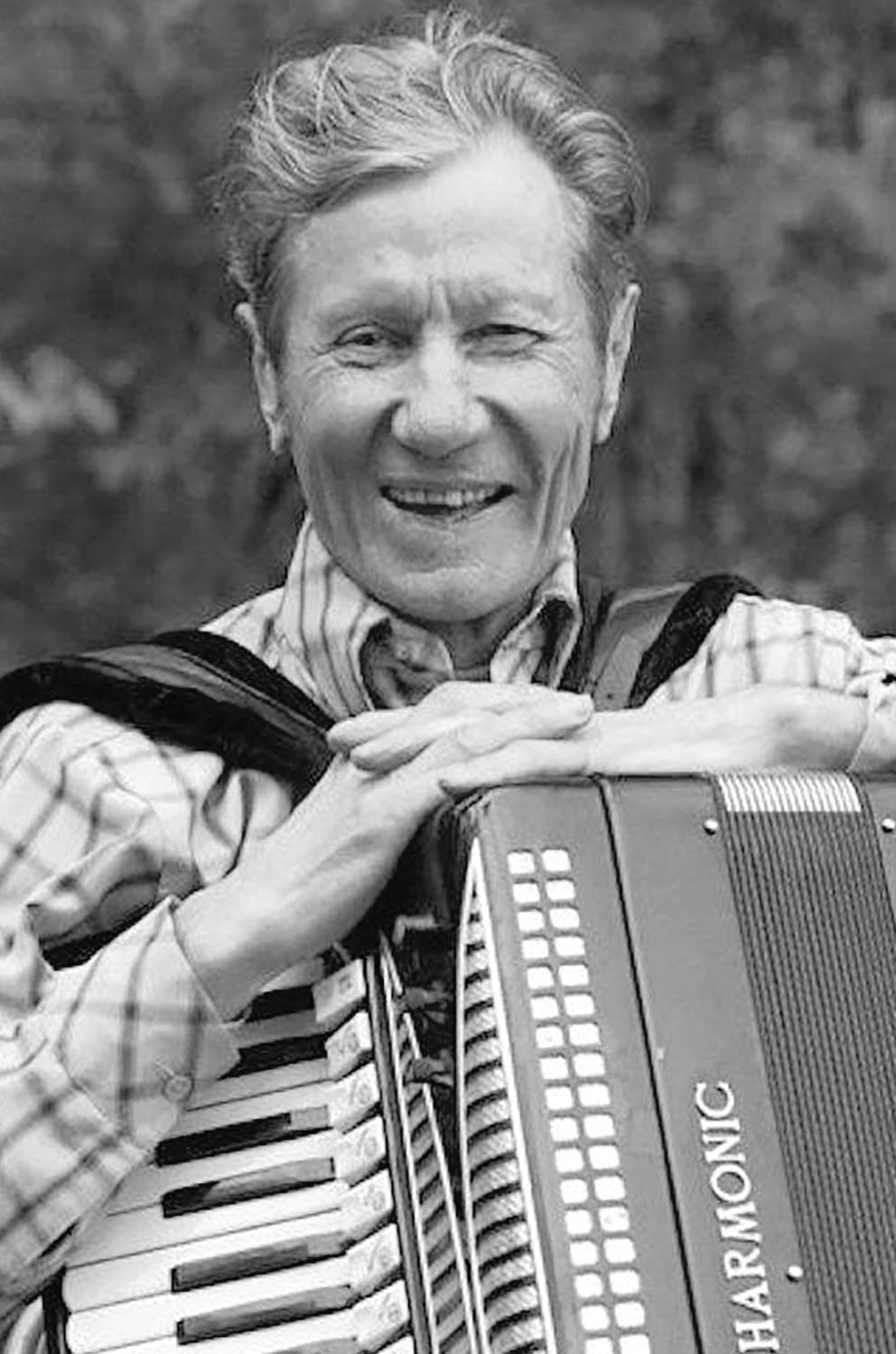
Randy Seppälä, Ralph Tuttila and Oren Tikkanen remain active musicians with their respective collaborating ensembles and are likely to be at Aura this summer or in the future.
Ameriikan Poijat Finnish Brass Band performed at the Aura Jamboree in 2011. There was a very warm and supportive audience, and our dance tunes filled the Town Hall floor with a surprising number of children gleefully prancing around with their parents, grandparents, and friends. That was one of my most encouraging experiences in Finnish music, affirming that there would be a new generation that heard and danced to the old tunes.
Here is a final excerpt from Helen Waisanen's interview. Interviewer: Do you think there's really anything about Aura that has helped to pass on these traditions and these ideas of having a Finnish American community? Helen: Well, I think that's where the hall has helped. A lot of communities like the community that I grew up in; the hall has been torn down years ago so there's no kind of central location for that kind of activities. I guess if you go to Ontonagon maybe, I really don't know. I really haven't been that involved with Ontonagon but there are still some folk musicians. There used to be Art Moilanen and Helmer Töyräs, they were always involved with the Jamboree from earlier years, and when Art was still running his bar and he'd come to the Jamboree and other musicians would come play. You know, he had a bar and that's where he played his traditional music and people would always flock to his bar because there was always dancing at Art's bar. So, some of the bars have continued that and many places too but I think the Aura Jamboree has helped keep that kind of ethnic tradition going all these years.
The upcoming Aura Jamboree (July 17-18th, 2026) talent lineup include the "Kivajat and Kuparieliet Dancers," probably North America's premier Finnish American youth folk dance programs, in two performances. At the time of this writing the 2026 stage schedule had not yet been announced. The Jamboree website is aurajamboree.org.