By Jeff Huebner
It has been several months since the April 5 closing of “Seeing Silence: The Paintings of Helene Schjerfbeck” exhibition at the Metropolitan Museum of Art in New York City, and the spell that this celebrated, singular Finnish artist—who lived from 1862 to 1946, and whose work bridged the gap between Realism and Modernism, even Abstraction—cast on us still lingers.
Not only was it the first major museum exhibit in the U.S. dedicated to her works—58 history paintings, landscapes, still lifes, portraits, and most notably, her late, haunted series of self-portraits; it was also, declared Consul General of Finland in New York Jarmo Sareva in the Fall 2025 edition of “The Finnish Line,” the publication of Finlandia Foundation National, “the most significant showcase of Finnish art in the United States in decades—if not ever.”
(An even bigger Schjerfbeck exhibit opened in the U.S. at the National Academy of Design in New York in 1992 and traveled to the Phillips Collection in Washington, D.C. The New York Times said then: “A Neglected Finnish Modernist Is Rediscovered.” Now she is rediscovered again.)
Schjerfbeck is largely unknown outside the Nordic Lands. But the prestige of the Met, perhaps the paramount art museum in the world, in collaboration with the Finnish National Gallery’s Ateneum Art Museum, Helsinki, affirmed her and her enigmatic, introspective, melancholic, luminous, and ghostly paintings a rightful place in modern art history. (While the exhibit almost exclusively showed her oils on canvas, she worked in many media.)
My wife Marj and I wanted to, had to, see the deservedly much-lauded exhibit—“a moving introduction to an artist whose name you probably do not know,” wrote Deborah Solomon in the Times (Jan. 2, 2026). So in January, we did what anybody in their right mind would do: we booked coach on an overnight Amtrak train from Chicago to Penn Station (and back), and then booked a room in a small hotel in the East Village, our favorite Manhattan neighborhood, for several days in late March and early April—the final days of the show.
We had never taken the fabled Lake Shore Limited to New York before and thought it would be a novel change of pace. Luckily, we had picked a good time to go; O’Hare and LaGuardia airports were having massive flight delays and cancellations due to the Iran War.
It was a mostly uneventful and not too uncomfortable 20-hour journey. (Bring food, though there is a dining car.) A friend in New York had earlier told us we should sit on the right side of the train, going east, from which we viewed the historic Erie Canal and the scenic 130-mile Hudson River Valley, including the Catskills, roughly from Albany to Yonkers, with its towering cliffs, mountains beyond rolling hills, and quaint riverside villages.
From where we stayed, it’s an easy 6 train (subway) ride to the Met. The contrast between the funky, eclectic street scene of the Lower East Side to the refined elegance of the Upper East Side is always a bit of a culture shock. Yet the Met is an invigorating democratic space—as long as you can afford the $30 admission (seniors, $22) to see its 100,000 artworks on display.
Among other sights, we visited the newly re-designed Studio Museum, which showcases African-American art in Harlem, a part of which was once known as “Finntown,” owing to its influx of Finnish immigrants in the early 20th century.
But Schjerfbeck was our main attraction, the impetus for our whirlwind urban adventure. She was worth the trip!
Hers, happily, gratefully, was a name we DID know. Over the decades during our Finland travels, we have viewed her works at several museums—most prominently, the Ateneum, which owns more than 200 of her works (130 were shown in a 2019 exhibit)—and also the outstanding Serlachius Museums in Mänttä, known as Finland’s “Art Town,” and others. They and many other institutions and private collections lent artworks to the New York exhibit, which was organized by Met curator Dita Amory. She also contributed insightful essays, among those by others, including Ateneum director Anna-Maria von Bonsdorff, to the richly illustrated catalog. Finnish-American philanthropist Elsa Brule provided financial support.
I had always thought that American art audiences should know more about this remarkable, resilient artist, and how she persevered through a life of adversity—not the least of which she was a woman in a patriarchal field. Said to be shy, introverted, and self-doubting, she lived in relative isolation for decades, battling illnesses—a childhood accident left her with a lifelong limp—personal setbacks, rejection in marriage, wars.
So we were thrilled to find out her work was being shown in the U.S., at the Met, no less, and that we had the opportunity of viewing most of her classic paintings all in the same place.
Born in Helsinki in 1862, Schjerfbeck was a child art prodigy. She was enrolled in the Drawing School of the Finnish Art Academy at age 11, and her early paintings of Finnish historical subjects—Finland was still under Russian imperialist rule, even as the grand duchy was forging its own national and cultural identity—earned her government grants to study for several years in Paris under the tutelage of classical Realist masters, and to take painting trips to the England and France seacoasts in the 1880s.
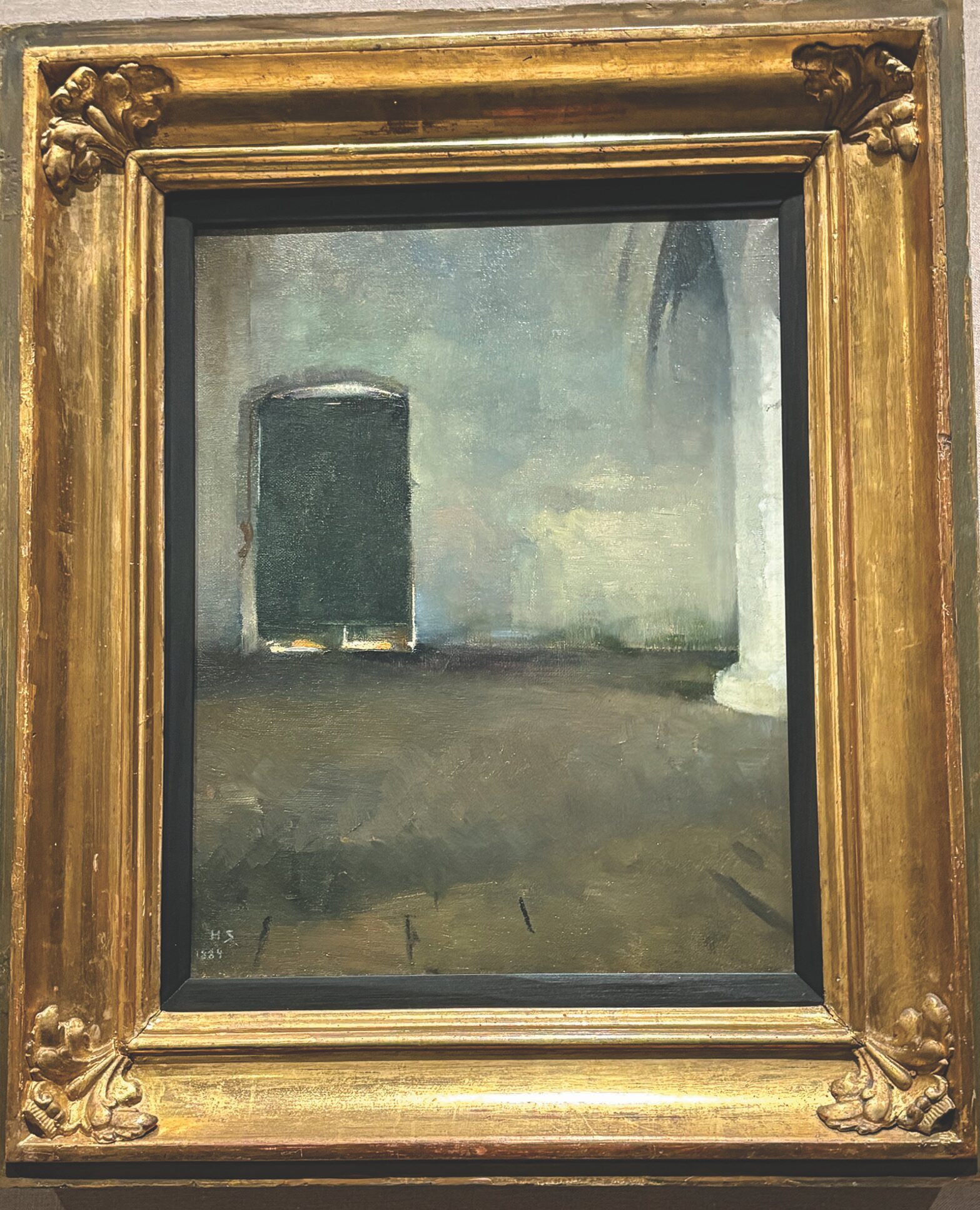
This era produced two unusual non-figurative paintings, among my favorites, that were exhibited at the Met: The mysterious The Door—what light radiates behind it? (It's set in a Breton chapel); and Clothes Drying, in which white sheets spread across the ground, in abstract-like smudges, is also cryptic. The Convalescent (1888), which shows a sick little girl touching a budding twig in a mug, is a beloved Finnish treasure.
She was variously influenced by Old Masters like El Greco, French painters like Manet and Degas, as well as Mary Cassatt, Whistler, and later, Cezanne.
Schjerfbeck returned, seasoned, to Finland in 1892 to teach at the Finnish Art Academy. A decade later, in frail health, she moved to Hyvinkää, a small town north of Helsinki, with her widowed mother Olga. She and local girls and women served as models, dressed in black or white and painted against bare backdrops.
Removed from Helsinki and European art trends, the painter started to come into her own. Her brushwork started loosening. Some figures seemed soft-focus, gauzy, glowing, as if they had been summoned from memory, or a dream. She started scraping and scratching her paint surfaces, as in the beatific portrait Fragment (1904). She "intended her paintings to retain a sense of process," observed von Bonsdorff.
Soon after her mother died, in 1923, Schjerfbeck moved to the charming seaside resort town of Tammisaari (Sw., Ekenas), between Helsinki and Turku.
Several years ago, we had also visited its Museum of Western Uusimaa (which since 2022 has been joined by the contemporary art museum Chappe). The Swedish-speaking artist lived here from 1925 to 1941. The older museum has partially recreated her studio, featuring artworks, her easel and rocking chair, photographs, and other personal effects. You can also watch a film about her life. (I bought a slim, attractive picture book titled Helene Schjerfbeck: Life and Work, by Sari Salo-Kiljo.)
Over the years, she honed down her figure paintings and still lifes to radically spare, stark, almost abstract pictures, "eliminating any extraneous elements," according to Met materials. The Bakery II (1941) and Still Life with Blackening Apples (1944), a metaphor for aging and decay, are virtually indistinguishable after the more legible renditions painted decades earlier—The Bakery (1887) and The Red Apples (1915).
While the Met acquired The Lace Shawl (1920) in 2023, you will have to go to Finland to view the bulk of her works.
In frail health, with World War II and the Soviet-Finnish wars raging, Schjerfbeck's Stockholm dealer, Gösta Stenman—who'd supported her career since 1917—moved the artist to a spa hotel outside the Swedish capital in 1944. It was here she painted her series of late, disturbing, even skeletal self-portraits, four of which were on view at the Met (and also four from the 1920s and 30s).
These works "stand among the most extraordinary self-portraits of modern times," Amory writes. Schjerfbeck died in 1946 and is buried in Helsinki's Hietaniemi cemetery.
While these late paintings make it hard for you not to contemplate mortality, they also make it hard for you not to celebrate her immortal art.
Author's note: My wife Marj commented how one rare painting used pastels (Girls Reading, 1907). A woman viewing nearby overheard, we got to talking, and it turns out she was a pastel artist from Wisconsin who was visiting New York for a Pastel Society of America workshop. And she wanted us to know about a great Master Pastelist in Rovaniemi, Finland—Pirkko Mäkelä Haapalinna. Terve, Pirkko!