By Maria Bouroncle
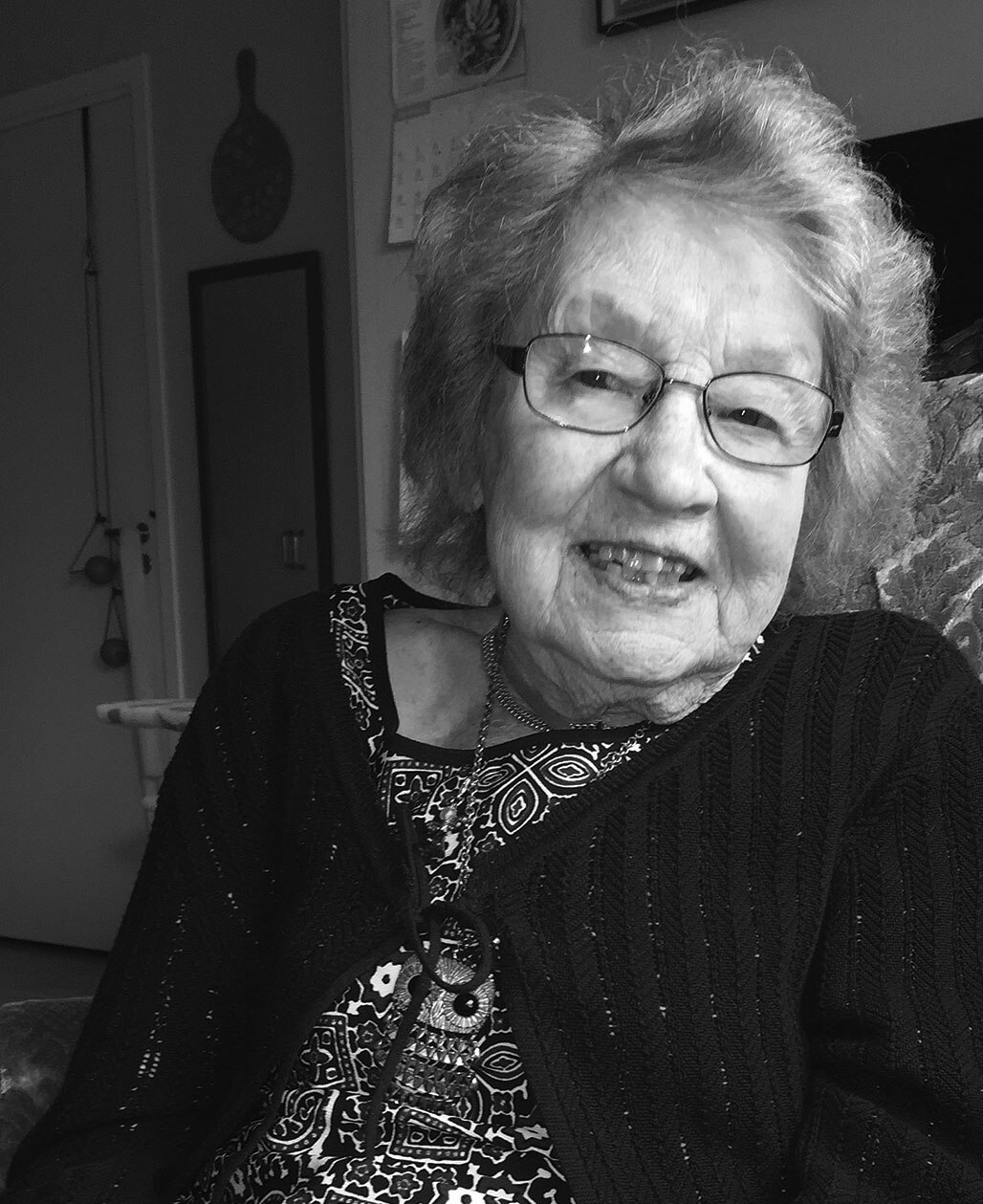
Hilja Nordner, born Kouhia, was one of around 70,000 Finnish war children evacuated to Sweden during the Second World War. Her life, marked by separation and displacement, has become the basis of author Maria Bouroncle’s book The Girl with a Nametag: The Story of a Finnish War Child, now published in English for the first time with support from Finlandia Foundation National.
Gäsene courthouse, 2018
On December 18, 2018, 86-year-old Hilja Nordner sits in Gäsene courthouse in southern Sweden. She is attending the launch of Maria Bouroncle’s first book, It Came to Me on a Whim: The Story of Ingeborg Andersson, Child Murderess. The courthouse is the same place where Bouroncle’s great-aunt once stood trial in 1929 for the killing of her and her husband Artur’s three children: Tor, Efraim, and Lucia. The room is carefully arranged: freshly ironed linen cloths cover the tables, and trumpet lilies fill the air with a scent that recalls the funeral flowers laid out nearly a century earlier in the church of Vesene.
Family members, neighbors, and others with ties to the area have gathered to talk about the tragedy. After decades of silence, memories begin to surface. As the conversation turns to the past, Hilja recalls fragments of a story she heard as a child, but like many in the village, she never spoke of it again. Until now.
“When she mentioned her maiden name, Kouhia, I realized who she was,” Bouroncle says. “Hilja passed away in October 2024, but we met repeatedly after that first encounter in 2018. We became friends, and The Girl with a Nametag would not have been possible to write without her support.”
War in Finland
Hilja was born on August 23, 1932 in Kivennapa, Karelia. In October 1939, when she was 7, the family’s newly built home was destroyed in Soviet bombing. Like some 420,000 Finns, her family was evacuated from Karelia. After the Winter War ended in March 1940, the territory was ceded to the Soviet Union.
Over the next two and a half years, the family moved repeatedly across the Savo region — from Joroinen to Mäntyharju, from Mäntyharju to Valtola, from Valtola to Pyhäkoski, and from Pyhäkoski to Asikkala. In June 1942, they returned to Karelia, which Finland had retaken during the Continuation War. Hilja and her siblings—Erkki, Sylvi, Antti, and Sirkka—lived with their grandparents while their father rebuilt their home on the remains of the barn.
But the return did not last. Within a year, the Red Army advanced again, forcing the family to flee. Hilja’s father was sent to the front, leaving her mother alone with five children. She read a Red Cross advertisement offering Swedish foster homes for children aged 2 to 12. She wrote to her husband for his opinion, but his reply — saying he did not like the idea — never reached her. She decided to send Hilja and her five-year-old brother Antti to Sweden anyway. Hilja was 12.
“Hilja’s eldest brother Erkki harnessed the horse and drove them to the nearest railway station in Mikkeli,” Bouroncle says. “After a day they reached Vaasa and boarded the ship that took them overnight across the Gulf of Bothnia. On the Swedish side they continued by train from Umeå via Stockholm to the small town of Herrljunga in southwestern Sweden. The whole journey took three days.”
Evacuation to Sweden
The story of The Girl with a Nametag begins when Hilja and Antti arrive in the village Vesene on September 10, 1944, after two weeks in quarantine. By then, Artur had divorced Ingeborg and Hilja was taken in by him and his new wife Maria. Despite Hilja’s promise to her mother to look after her younger brother, the siblings were separated at the train station.
Hilja weighed only 55 pounds when she arrived in Sweden. She was starving, and even decades later she would recall the abundance of food on the farm. The bread was sweet, and she tasted hot chocolate for the first time. She missed her family deeply, but gradually adapted to life on the farm with Aunt Maria and the quiet Artur. The work was, in many respects, the same as in Finland.
“Hilja helped with the hay harvest, planted potatoes, and prepared pickles and preserves,” Bouroncle says. “She loved animals and formed a particularly close bond with the horse Blaze.”
She also began school and made new friends. In Finland, she had only attended school for two weeks before the war broke out. In Sweden, which remained outside the war, everyday life continued as normal.
Return to Finland
After two years, it was time for Hilja to return to Finland. Her brother Antti, who had contracted tuberculosis, remained in Sweden for another year. His foster parents wanted to adopt him, but his Finnish parents refused.
“Hilja was excited to come home,” Bouroncle says. “Her older sister Sylvi had started going out dancing, and Hilja, who had just turned fourteen, was allowed to join her.”
She had kept in touch with her family throughout her time in Sweden. Once back in Finland, the correspondence shifted direction. When Artur and Maria learned that Hilja longed for apples, a ten-kilo parcel soon arrived—filled with red autumn apples and other treats. Another package contained fabric for a confirmation dress.
“When she was 17, she wanted to return to Sweden,” Bouroncle says. “Artur and Maria gave her money for the ticket and welcomed her back with open arms.”
A wish for peace
When Hilja married the farmer Åke Nordner nine years later, the wedding celebration was held on Artur’s and Maria’s farm. Hilja gained a kind but somewhat shy husband, two daughters, a productive farm with 50 cows, and a life that, in her own words, gave her everything she could have dreamed of.
The Finnish edition, Tyttö lappu kaulassa: Suomalaisen sotalapsen tarina, was published in 2024. The Swedish original, Flickan med en lapp om halsen: Historien om ett finskt krigsbarn, appeared on March 9, 2022, less than two weeks after Russia’s full-scale invasion of Ukraine. Hilja’s hometown, Kivennapa in Karelia, was ceded to the Soviet Union in 1944 and has been part of the Russian Federation since 1991. It is now known as Pervomayskoye.
“I wish for peace in the world because war is harmful to everyone,” Hilja used to say. “I wish the same,” Bouroncle concludes.
Editor’s note: Maria Bouroncle is an author, lecturer, and writing teacher. She made her debut in 2018 after a long career in international development. Her historical trilogy about young women in the early 20th century has been adapted for film, translated into several languages, and is used in a literature course at UCLA. She has received several awards for her writing in Finland, Sweden, and the United States. In spring 2026, she was a writer in residence at the University of Michigan, where she also taught Swedish literature and creative writing. Born in Gothenburg, Sweden, she has lived in Washington, D.C., since 2002.