By Jerry Mevissen Driving south a few hundred miles on US 71 from the Minnesota-Canada border to Mexico, you'll pass through Menahga, a name derived from the Ojibwa word for blueberries aplenty. It's not a big town (current pop. 1,374) so stay alert, because on your left is a larger-than-life statue of St. Urho, pitchfork held high with grasshopper impaled. Who is St. Urho? Why, he's the patron saint of Finnish grape workers, credited with salvaging the grape crop by driving grasshoppers out of Finland. Fantasy or fiction, who cares? It's cause for an annual celebration the day before St. Patrick's Day. Get the idea there might be a hint of competition going on? Behind St. Urho, shrouded in spruce, is the Menahga Historical Museum. The statue appropriately predates the museum, giving its construction divine guidance. Plans for the museum began in late 1986. Fund raising kicked in in 1986, and the building plan for a 40- by 80-foot concrete structure was approved in 1987. By Midsummer Celebration Days in mid-July 1990, the interior was completed, artifacts were donated, displays were organized, and the doors swung open to the public. In 2012, a 54 by 120 feet of exhibit space was added. Today, Museum membership hovers around 100. It's a 501(c)3 organization with funding derived from donations, grants, and support from Wadena County. Volunteers staff the museum, which opens on Memorial Day and closes Labor Day. The Museum also serves as an event center. A brief history of the area: Finnish migration to America began in mid-19th century and reached its peak between 1870 and 1929, when an estimated 350,000 Finns emigrated and settled in Michigan, Wisconsin and Minnesota. Economic hardship coaxed them to make the perilous journey, and the promise of land and relative prosperity cemented the decision. Imagine days, weeks on the stormy Atlantic with meager food and comfort. Imagine landing in New York, then boarding a train to Minnesota. Imagine detraining in New York Mills, Minnesota, after seeing (and expecting) New York City. The new Americans walked or hitched a ride through untamed wilderness with the local mail delivery man to their 160-acre homestead. Imagine the challenge of facing 160 acres of red and white pine waiting to be cut for a cabin and land waiting to be cleared for farming. Imagine hiking back to New York Mills for axes, awls, saws and hardware. And imagine a Minnesota winter approaching.
According to museum President Gloria Markkula, the mission of the museum is to preserve the lifestyles and life choices of the past and showcase how different (and difficult) life was. And how far we've come. The mission also includes community service. The Museum sponsors a pancake breakfast for St. Urho's Day and hosts tours for local history classes.
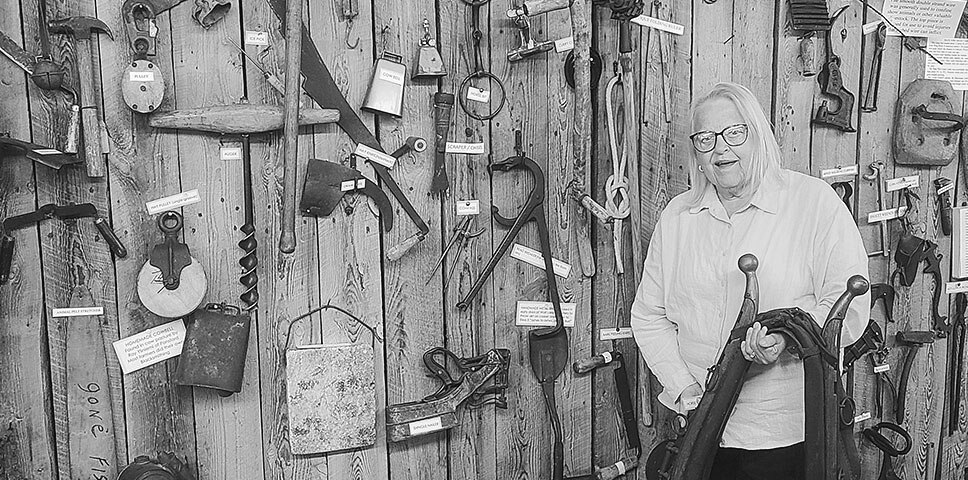
The most significant Museum display features military artifacts — uniforms, flags, medals, newspaper clippings and books. It's Gloria's pet project, and she's eager to show what it was and what it has become. Other exhibits include a 1925 mint condition Model T Ford, a 1903 Waterous Pumper fire truck, a 1913 Doctor's buggy, vintage clothing including wedding dresses, a collection of Finnish knives, a wall of pioneer farm and logging tools and implements, a reconstructed country school classroom, and of course, a wall of St. Urho memorabilia. There's a player piano, a church organ, a general store counter, an old printing press and much more.
For us old 'Mad' magazine fans, there's a wall exhibit dedicated to Menahga hometown hero Wally Wood, satirical illustrator and star artist of the 1950s.
About St. Urho. You'll read in "Menahga Memories 1892-1992" that the legend of St. Urho originated in Virginia, Minnesota, where Richard Matson, a department store manager, wished to irritate his Irish neighbors as they celebrated St. Patrick's Day. He published the story in the March 17, 1956, edition of a local paper, and the story was picked up by the "Menahga Messenger" and repeated annually.
This led to calls for a statue honoring St. Urho and for Menahga to be the resting place for said monument. It took decades for the legend to be researched and created, and the statue to be designed and built — not unlike the canonization protocol for any saint, only more complicated if the saint is imaginary.
The first statue was to be carved oak by a Twin City sculptor, but five years later, still no sculpture. Then a local chainsaw artist Jerry Ward retrieved the oak block in the winter of 1982 and carved the statue in time for the March 16, 1983, celebration. Hurrah! Let the games begin.
Vandalism and extreme environment took their toll on the wood statue, and it was replaced with a fiberglass model.
Currently, the Knytes of St. Urho, in prescribed regalia of purple long johns and Nile green capes, and their female compatriots the Nighties shed their Monday through Friday stoicism and cavort among the celebrants of St. Urho's Day with uncharacteristic mayhem. Fun for all.
So, with guidance from factual or fictional St. Urho, the town of Menahga thrives, commercially, with a full spectrum of goods and service establishments; educationally, with a new public K-12 school; culturally, with the annual Spirit Lake Music Festival and Mid-Summer Music Fest; recreationally, with an inviting Memorial Park and campground, tennis courts, and golf course. This plus a health care clinic, full complement of churches, and not one but two ice cream parlors. Add to that an Historical Museum that understands planning our future requires knowledge of our past. The Menahga Historical Museum is a repository of that knowledge and proclaims it proudly.