By Jim Ronka
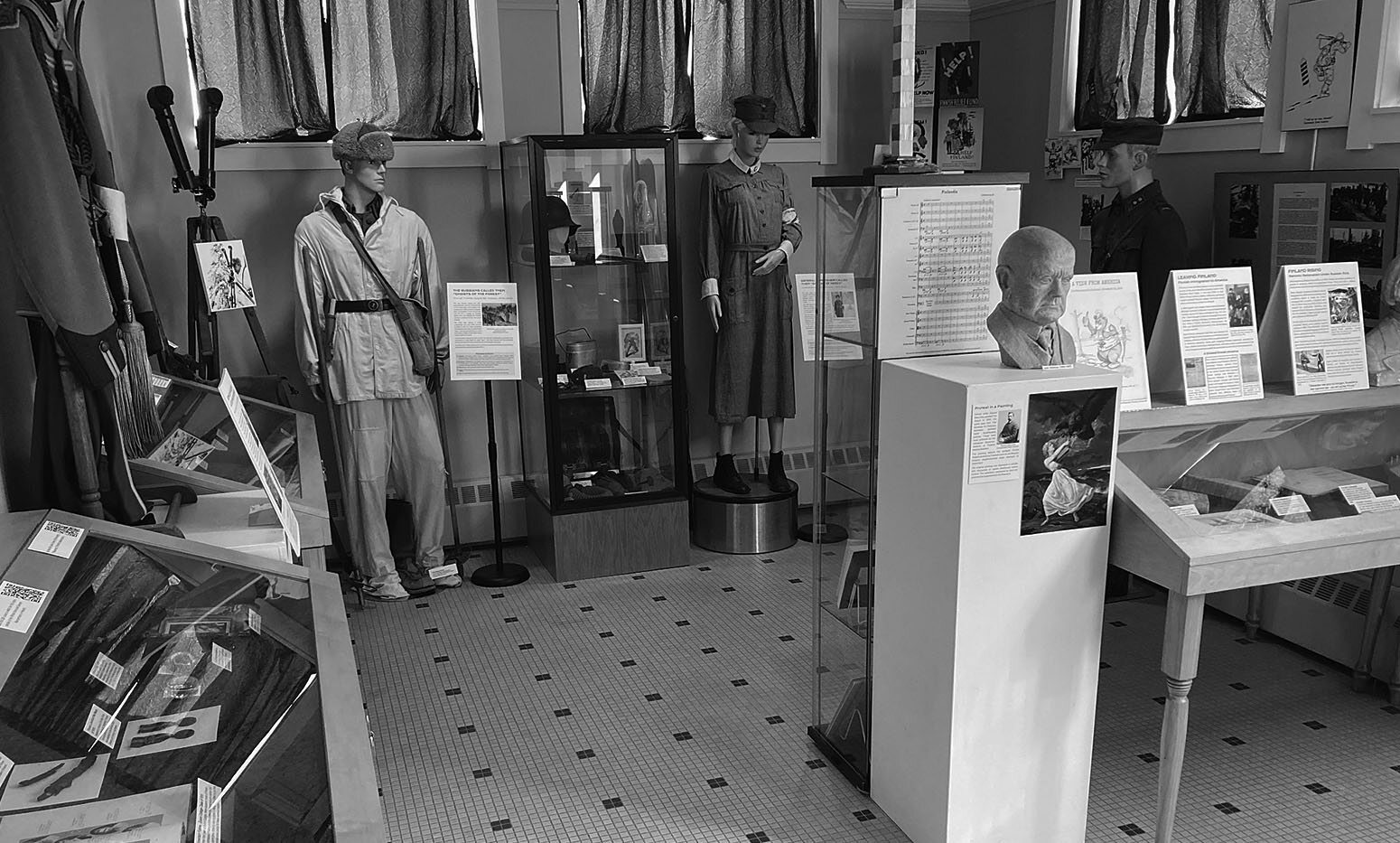
What an amazing journey this has been! The museum exhibit I was hired to build at the Finnish American Heritage Center in Hancock, Michigan is nearly complete. The exhibit's title sign should be up by the end of this week: “Sisu, Sacrifice, and Survival: Finland’s Fight for Freedom.”
This label captures the exhibit's interpretation of Finland’s path to independence and the defense of that freedom during World War II. The exhibit is scheduled to officially open on December 3, 2026, coinciding with the Heritage Center’s annual commemoration of Finland’s independence Day, but visitors can interact with the exhibit now as it nears completion. As part of the exhibit development process, Finlandia Foundation National (FFN) is partnering with three premier military museums in Finland to conduct a Finnposium webinar on October 27. The directors of the Finnish Defence Forces Museum (Helsinki), the Infantry Museum (Mikkeli), and the Lotta Svärd Museum (Tuusula) will join Tommy Flanagan (FFN Executive Director) and me (FFN Curator of Special Exhibits) to explore the transatlantic experiences of the 1939-1940 Finnish Winter War.
I am incredibly grateful for the opportunity to develop an exhibit experience that will help Finnish Americans connect with Finland’s history and explore their heritage that might intersect with wartime Finland. Here in the final week of another work trip to Hancock (my fourth), I have gazed out my Quincy Hill Airbnb’s window at the views across the Portage Canal and reflected on the past 11 months of this project — a project that evolved in ways I never anticipated and has led to many Finnish-American heritage discoveries.
It seems like a lifetime ago when I embarked on this rather unexpected journey.
“This job seems to be purpose-built for me!” That is what I told my wife in June 2025 as I reviewed the FFN job announcement seeking someone to curate the “Price of Freedom” militaria collection into an exhibit about the 1939-1940 Finnish Winter War. Curator experience? Check — I’ve been volunteering in the museum community as a curator, docent, archivist, and managing committee member since retiring from the U.S. Navy in late 2009. Historian experience? Check — I’m pursuing a master’s degree in public history. Appreciation of Finnish-American heritage? Check — I’m a third generation Finnish-American with roots in the Lanesville, Massachusetts Finnish immigrant community and a member of two FFN chapters, Cape Ann Finns and Finlandia Foundation Colorado. War history nerd? Check — I’m a military reenactor and have studied the Finnish Winter War out of personal interest.
The wild card was the extensive travel to the exhibit location at the FAHC in Hancock. I live in Colorado. What would weeks on Michigan’s Keweenaw Peninsula look like? My wife and I decided to travel to Hancock to find out, flying to Chicago in late June and taking a leisurely drive north. I really didn’t know what to expect in Hancock. I’ve been an FFN member for decades and had probably absorbed some level of Hancock news, but hadn’t really connected the dots as to the cultural significance of Copper Country to Finnish America.
We rolled into town and I immediately sensed Hancock’s Finnishness. Finnish flags were flying from the streetlamps. Finnish names were on the street signs. And the faded words “Kaleva Café” could be seen on the side of a brick building, a memory of Finns gone before. Yes, this was definitely Finland in America revealing itself. We walked down Quincy Street and happened upon a street map mural of Hancock in 1890. What caught my eye was the “Finnish Lutheran Church” near the eastern end of Quincy Street. I did my homework before the trip and had reviewed the translated journals of my great-grandfather Samuel Rönkä. Reverend Rönkä was a Finnish Lutheran missionary in German Southwest Africa from 1895 to 1902 and was then called to be a pastor in the United States. He and the family (including my grandfather) passed through Hancock in 1903 when he checked into the Suomi Synod headquarters at Suomi College; stayed in Old Main (the building that housed all the college’s functions at that time); and preached at Hancock’s Finnish Lutheran Church. We made a beeline to the end of Quincy Street and there it stood just up Reservation Street, the former St. Matthews Evangelical Lutheran Church building. Granted, my great grandfather preached in the original building which burned down in 1909 and was replaced by the currently standing one, but the Finnish immigrant heritage connection was made. I rounded out the two-day visit with a stop by North Wind Books (selling all things Finnish) and some research in the FAHC archive where my great-grandfather’s pastoral career is well-documented. Through all of this, I was gathering information to help make the job application decision.
During the drive back to Chicago and the flight home to Colorado, my wife and I considered how the job could fit into our busy life. We decided that the door of opportunity was opening and we should walk through it, not quite knowing how we would manage the trips to Hancock, especially during the notoriously difficult Upper Peninsula winter months. But our brief taste of Finnish-American heritage sealed the deal. I applied for the position and was hired in mid-October 2025, with my first “official” work trip to Hancock scheduled for two weeks later that month.
Bright and early Monday morning I showed up at the FAHC, checked in with David Maki, the FAHC Director, and went down to the archives, my new home away from home. There I discussed the exhibit project with Joanna Chopp, the FAHC Archivist (we had met during my June trip), and she showed me where the Price of Freedom collection was stored and partially displayed in an exhibit space in the FAHC’s lower level.
The Price of Freedom collection includes more than 2,000 “three-dimensional” objects and archival materials related to Finland’s military history, ranging from battle shrapnel of the Finnish Civil War to a piece of the engine cylinder head from the helicopter that crashed in Vietnam carrying U.S. Army Special Forces legend Larry Thorne (birth name Lauri Törni), Finnish war veteran and winner of the Mannerheim Cross (Finland’s equivalent of the Medal of Honor). The Price of Freedom collection was donated to Finlandia University by Harry and Ritva Manner in 2022 and displayed in a university building. The collection had previously been displayed at the Price of Freedom Museum at Finland House in Lantana, Florida, where Harry was the curator. When Finlandia University closed its doors in 2023, the Price of Freedom exhibit was dismantled and stored, with a small portion going on display after Finlandia Foundation National purchased the Finnish American Heritage Center and its archive. My job was to bring the collection back to life in the form of a traveling exhibit for display at FFN chapters.
I unpacked every box to understand what I had to work with and began my research. What became increasingly clear is that Finland’s World War II experience did not happen in a historical vacuum, but was connected to centuries of Finland’s geographic destiny as a gateway between East and West. This expanded story arc began to reveal itself through the objects in the Price of Freedom collection, while creating an opportunity to include other artifacts from the FAHC archive.
Still tracking on a traveling exhibit concept, I went back to Colorado to brainstorm the mechanics of sending an exhibit on the road, soon concluding that the logistical challenges and shipping costs of a traveling exhibit exceeded realistic resource expectations.
Consequently, we shifted the deliverable, deciding to focus on creating a more complete and comprehensive exhibit at the Finnish American Heritage Center that captures the complete history that led to Finland’s experience in World War II. From the interaction I’ve had with exhibit visitors in March, June, and now September, it was the right decision. The overall response has revealed genuine interest in understanding the complexity of Finland’s history and how Finnish Americans are connected to its milestone events, especially those of the 19th and 20th centuries. At the same time, we are developing an online component and an exhibit lecture that tours FFN chapters in 2027 with a sampling of relevant artifacts.
One story that Finlandia Foundation National is particularly well-positioned to tell is that of America’s experience during the Winter War. Finnish Americans were instrumental in supporting Finnish relief efforts and nearly 300 Americans volunteered to join the Finnish military to fight the Soviets. The FAHC archive preserves the records and books that tell many of these wartime stories, as well as the experiences of Finnish war survivors who immigrated to the United States after World War II.
One goal of this exhibit is to compel visitors to consider where and how their Finnish ancestors experienced Finland’s war events. Although my Finnish great grandparents (Rönkä and Seppälä) had immigrated to the United States by 1903, I have no doubt that there are distant relatives of mine who lived through World War II in Finland, either as civilians subject to Russian bombardment (or evacuation from combat areas), as soldiers on the front lines, or as Lotta Svärd women’s military auxiliary members. And even for those who do not have a personal connection to Finland’s wartime history, our hope is that they can learn something from the exhibit’s displays and become more informed Finnish Americans or friends of Finland in America.
As I near the end of this exhibit project journey, I am grateful for the privilege to help tell the story of Finland’s fight for freedom and to preserve the memory of Finns who sacrificed to keep Finland independent. I am also grateful for the unexpected encounters with Finnish-American heritage in Hancock, Finnish America’s “nesting place.” These experiences read like a bucket list — touring an early-twentieth century Finnish homestead; experiencing Juhannus mid-summer festivities; meeting the Ambassador of Finland to the United States; touring Suomi College’s Old Main and walking the same hallways that my great grandparents and grandfather walked in 1903; attending a Sunday evening Vespers church service at Jacobsville Chapel, a country church started by Finns in the sandstone quarry community an hour southeast of Hancock; discovering that a great-great-uncle Seppälä is buried just north of Hancock in Calumet. But most importantly, I have gained a more meaningful appreciation of what our ancestors endured and survived so we can call ourselves Finnish-Americans.