By Gage "Touko" Keränen
Ever since Finnish immigrants began to arrive in Michigan's Copper Country at the end of the 19th century, they have left a profound impact on the local culture which persists to this day. While most descendants of these immigrants don't speak Finnish now, they may have saunas, bake nisu, or remember a collection of Finnish words.
Now, imagine what would be left behind in the 25th century. Will there still be traces of Finns 500 years later?
Thanks to the Kreevins, a Finno-Ugric people found in the Zemgale region of Latvia, we know that it is indeed possible.
Cousins to the Finns, the Kreevins were descendants of a mixed Votic and Izhorian population from western Ingria. They spoke a dialect of the Votic language, which is closely related to Estonian.
Although there were no Kreevins left by the year 1900, their impact on Zemgale lives on in the local culture.
The mystery is: How did they end up so far away from their native land? And where did they go?
Nobody can say for certain, but Dmitrijs Ščegolevs, a sociologist from Saint Petersburg, has spent years in Latvia, piecing together the story of the Kreevins and investigating the traces that they left behind.
One possibility is that the Kreevins were prisoners of war brought to Latvia by the Livonian Order around 1440-1447 to build a castle in Bauska, but Ščegolevs' hypothesis is that they were brought for other reasons.
"In the mid-15th century, the Bauska area was a frontier zone that the Livonian Order needed to populate, cultivate and economically develop," he explained. "These captives represented useful human capital: farmers, craftsmen and people accustomed to living in a similar northern agricultural environment."
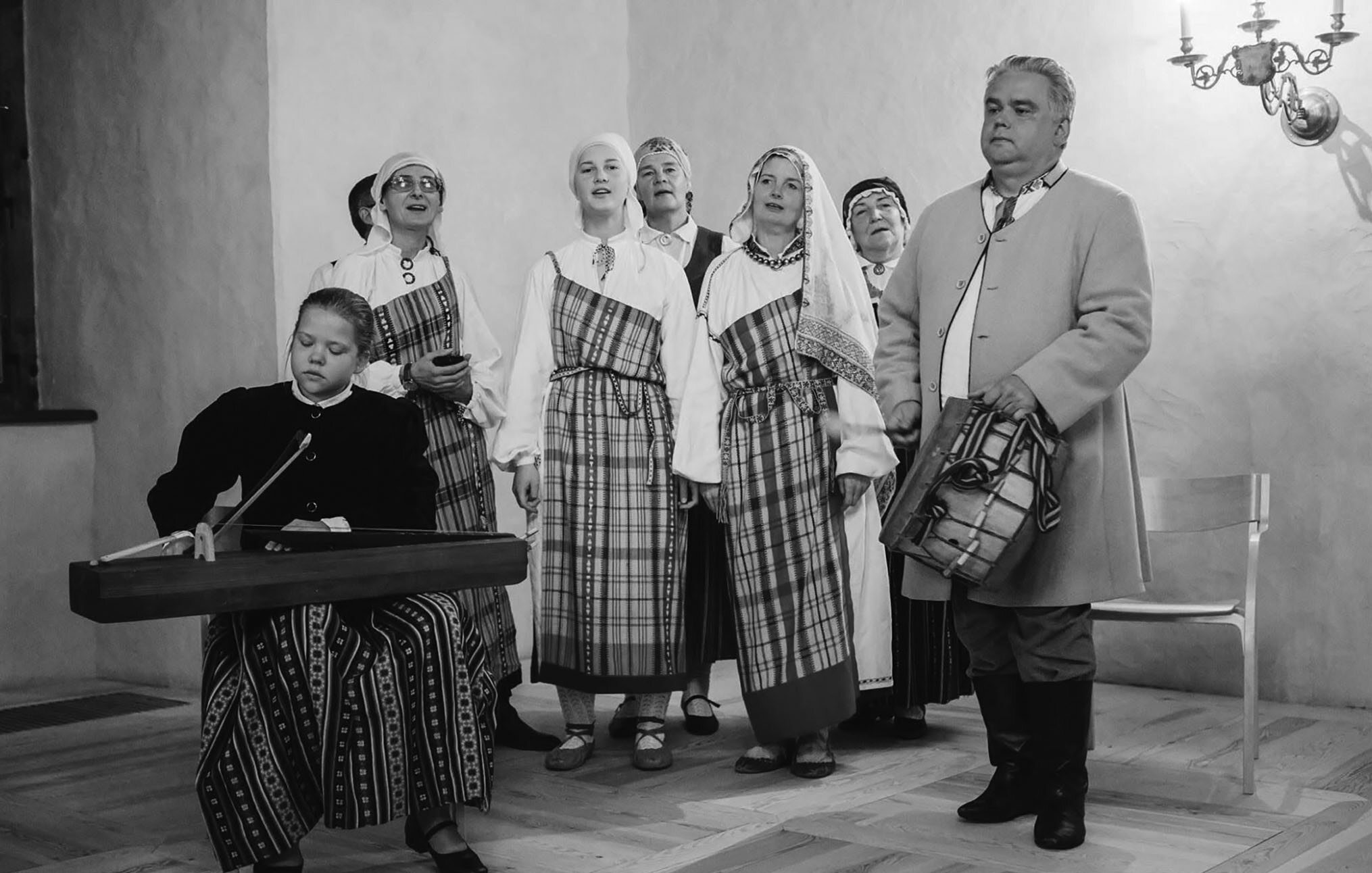
It is estimated that up to 3,000 Kreevins were brought to Zemgale and the region is home to their descendants.
Naturally, they have left a mark on the local culture, visible for those who know where to look. This influence often appears as place names, family histories, and grave markers.
Although unconfirmed, it is suspected that even the traditional Latvian women's skirts of Zemgale have a Kreevin origin, with vertical lines of flowers decorating the fabric, unlike other regions of Latvia which have vertical stripes.
"The Kreevins may have disappeared as a separate ethnic community, but they did not necessarily disappear from Zemgale. They may have become part of Zemgale," Ščegolevs said.
Thanks to historical paintings and descriptions of Kreevins, we know that Kreevin men often wore hats with a red top and shirts with embroidered collars. Women wore embroidered shirts, head coverings, and plaid skirts. These items of clothing hadn't been seen in Zemgale for over a hundred years, but things are beginning to change.
Locals are discovering their ancestry and some have begun to use "Kreevin" to describe their background.
"People are researching their family histories, rediscovering Kreevin places, reconstructing clothing and traditions," Ščegolevs said. "When somebody discovers that a grandmother came from a particular village, or that a family name appears in historical material connected with the Kreevins, suddenly this is no longer abstract medieval history. It becomes family history."
Next year marks the 580th anniversary of the Kreevins' arrival in Zemgale. For Ščegolevs, this is an opportunity to increase public awareness, start new research, and connect the Kreevin heritage to the Finno-Ugric world.
"For a long time, the Kreevins have been presented primarily as an exotic footnote to Latvian history. But if we place them within the wider Finnic world — alongside the Votes of Ingria, Izhorians, Livonians, Estonians, Setos and other related communities — suddenly their story makes much more sense."
To anyone who is seeking to piece together the story of their heritage, Ščegolevs has some helpful tips.
"Don't fill the missing pieces too quickly," he cautioned. "When people rediscover lost heritage, there is a natural temptation to create a beautiful, complete story. But sometimes the empty spaces are themselves historically important."
Interested to learn more about the Kreevins and their upcoming anniversary festivities? Read more at the Kreevin website: www.kreeving.com.
We're nearly to the end of the Finno-Ugric festival year in Hancock, Michigan! If you'd like to learn more or plan a trip, visit FinlandiaFoundation.org/Hancock2026. See you there! Nähdään pian!